Syncro vs NinjaOne: Which RMM Fits Your MSP?
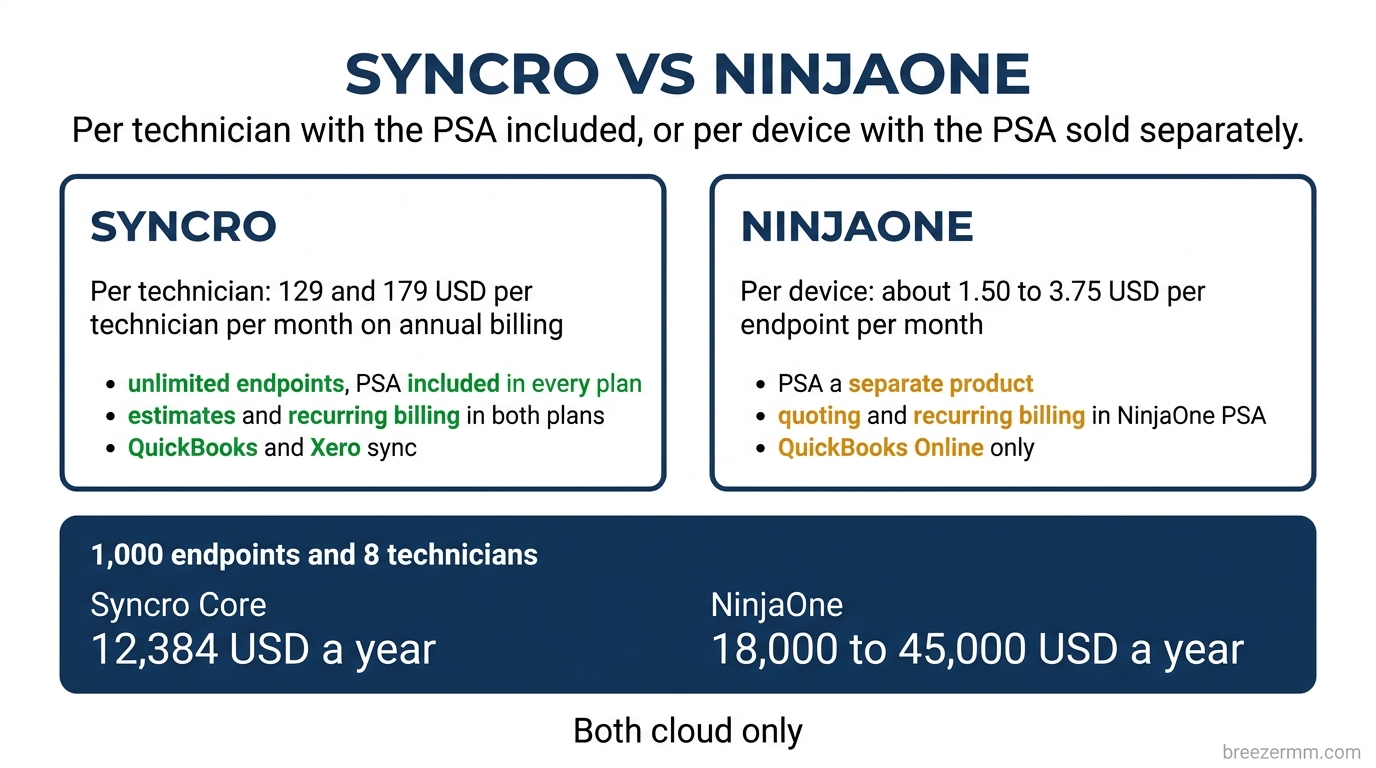
Syncro and NinjaOne solve the same problem and charge for it in opposite ways. Syncro sells one license per technician, with the RMM and the PSA inside it and no cap on endpoints. NinjaOne charges per device for the RMM and sells its PSA, backup and other products alongside. So the comparison comes down to two questions: how many endpoints does each of your technicians manage, and do you want the PSA in the same price?
Here is the short version up front. Pick Syncro if you want tickets, quoting, billing and RMM under one login at a price you can read off a page, and each of your technicians covers a good number of endpoints. Pick NinjaOne if you run few endpoints per technician, already have a PSA you like, or care most about patch management and a polished console. The rest of this post is the detail behind that, with every figure tied to a source.
A disclosure before the detail: this blog is published by Breeze, an RMM and PSA vendor that competes with both products. The prices below were read from each vendor’s own pricing page in November 2026, and the contract ratings come from our 2026 RMM pricing index. Vendors change pricing without notice, so confirm current numbers before you budget.
Pricing model: per technician vs per device
Syncro publishes exact prices. Core is $129 per technician per month on annual billing, or $159 billed monthly. Team is $179 on annual billing, or $209 billed monthly. Every plan includes RMM and PSA with unlimited endpoints per technician. Its pricing page offers a 14-day free trial with no credit card. The detail is on our Syncro pricing page.
NinjaOne publishes a range. Its pricing page says it starts as low as $1.50 per endpoint per month at 10,000 endpoints, rising to $3.75 at 50 endpoints or fewer, and that the price varies by region and by the products purchased. Onboarding and training are free. The breakdown is on our NinjaOne pricing page.
Which one costs less depends on one ratio: endpoints per technician. Here is how it plays out per year at the fleet sizes our index models, using Syncro Core on annual billing and NinjaOne’s published floor and ceiling. The Syncro figures are the rate times the number of technicians times 12. The NinjaOne figures are estimates from its published range, not quotes.
| Fleet | Syncro Core, per year | NinjaOne, per year (floor to ceiling) |
|---|---|---|
| 50 endpoints, 1 technician | $1,548 | $900 to $2,250 |
| 250 endpoints, 3 technicians | $4,644 | $4,500 to $11,250 |
| 1,000 endpoints, 8 technicians | $12,384 | $18,000 to $45,000 |
| 10,000 endpoints, 40 technicians | $61,920 | $180,000 to $450,000 |
Two things to read from that. At 50 endpoints the Syncro seat sits inside NinjaOne’s range, so a solo technician should price both. From about 1,000 endpoints with eight technicians, Syncro is below NinjaOne’s published floor, and the gap widens as the fleet grows.
The second caution matters more than the table. The two prices do not buy the same thing. Syncro’s price includes the PSA. NinjaOne’s does not, so add its PSA quote before you compare.
Contract terms and lock-in
Both sit at the friendly end of the market.
Syncro offers monthly or annual billing, with the lower rate on annual. There is no endpoint cap, so there is no overage math when a client adds machines. Our pricing index rates its lock-in risk Low.
For NinjaOne, a customer who is not in a promotional commitment can cancel with 60 days of notice. The index rates its lock-in risk Low to Medium. If your quote includes a promotional rate, ask what commitment comes with it and get the answer in writing.
Features: where they actually differ
Both cover monitoring, patching, scripting and remote access. The differences are in six places.
PSA. Syncro includes it in every plan: one license covers ticketing, billing, RMM and scripting, with established QuickBooks and Xero sync. NinjaOne PSA has been generally available since early 2026 and is built natively into the NinjaOne platform, but it is its own product with no published price. Its accounting sync is QuickBooks Online only.
Quoting and recurring billing. Syncro includes estimates and recurring billing automation in both plans. On the NinjaOne side both are part of NinjaOne PSA, so they come with that separate product.
Patch management and polish. This is NinjaOne’s strongest ground: a polished interface, fast onboarding, and strong patch management with broad third-party coverage. Syncro patches too, but that is not what people choose it for.
Network monitoring. Syncro puts Network Discovery on the Team plan and not on Core. NinjaOne has SNMP monitoring and network discovery, and its page says custom pricing is needed. On both, it is more than the entry price.
Privileged access management. Syncro offers it through AutoElevate, billed in arrears on your Syncro invoice at a price Syncro does not publish. We found no elevation feature on the NinjaOne site.
Backup and AI. Backup costs extra on both. Syncro sells Microsoft 365 Cloud Backup at $1.90 per user per month, and NinjaOne sells backup as a paid add-on or in a bundle. Syncro puts its AI capabilities on the Team plan, free through January 2027. NinjaOne has an AI product called Katana AI, and its pricing page does not say whether the price includes it.
Head-to-head at a glance
| Dimension | Syncro | NinjaOne |
|---|---|---|
| Pricing model | Per technician, unlimited endpoints | Per device |
| Published price | $129 and $179 per technician per month on annual billing | About $1.50 to $3.75 per endpoint per month |
| Cancellation and term | Monthly or annual billing | 60 days notice outside a promotional commitment |
| Lock-in risk (index rating) | Low | Low to Medium |
| PSA | Included in every plan | NinjaOne PSA, a separate product |
| Quoting | Estimates in both plans | In NinjaOne PSA |
| Recurring billing | In both plans | In NinjaOne PSA |
| Accounting sync | QuickBooks and Xero | QuickBooks Online only, in NinjaOne PSA |
| Network discovery | Team plan only | Available, by quote |
| Privileged access management | Through AutoElevate, billed separately | Not listed |
| Backup | Microsoft 365 backup at $1.90 per user per month | Paid add-on or bundle |
| AI | On the Team plan, free through January 2027 | Katana AI. Not stated whether the price includes it |
| Deployment | Cloud only | Cloud only |
For the same comparison across every vendor, see the tables in our best RMM software guide, and best PSA software for the PSA side on its own.
Which should you choose?
You want one login for tickets, billing and RMM. Syncro. That is what its license is.
Each of your technicians manages a large fleet. Syncro. Per-technician pricing gets cheaper per endpoint as the ratio rises, and from about 1,000 endpoints it is below NinjaOne’s published floor.
You staff heavily, with few endpoints per technician. NinjaOne is likely the better fit, because you are not paying for seats to deliver a higher service level.
You already run a PSA you are happy with. NinjaOne. Syncro’s bundled PSA is a smaller advantage if you will not use it.
Third-party patching is the main workload. NinjaOne, on the strength of its patch coverage.
You use QuickBooks Desktop or Xero. Syncro. NinjaOne PSA syncs with QuickBooks Online only.
If you are leaving one of them, our lists of Syncro alternatives and NinjaOne alternatives line up the rest of the market against each.
Where Breeze fits
Full disclosure, this is our product, so weigh accordingly. Breeze is an open-source RMM with a built-in PSA, licensed under AGPL-3.0. Like Syncro it puts the RMM and the PSA in one system, and like NinjaOne its hosted plan is priced per device, with the rate published on the pricing page. The self-hosted Community edition is free with unlimited devices and technicians. Quoting, recurring contracts, network monitoring and privileged access management for Windows are part of the platform, along with the workers, its built-in AI.
The honest caveats: Breeze is younger than either product. Its PSA syncs with QuickBooks Online only, where Syncro also syncs with Xero, and NinjaOne’s patch management and console polish are ahead of ours today. Because Breeze Cloud is priced per device, a team where each technician manages a large fleet will pay less on Syncro. The detailed head-to-heads are on Breeze vs Syncro and Breeze vs NinjaOne.
Bottom line
Pick Syncro if you want the PSA in the price and your technicians each cover a good number of endpoints. Pick NinjaOne if your endpoint-to-technician ratio is low, you already have a PSA, or patching depth and console polish matter most. Both have lighter contract terms than the quote-only vendors, so neither choice traps you. Before you sign either, count your endpoints per technician, get a NinjaOne quote that includes the PSA, and compare that total with the Syncro seat price.
Run Breeze on your own fleet
Start the Cloud Beta in minutes, or deploy for free with Docker Compose.