Atera vs Syncro: Which RMM and PSA Fits Your MSP?
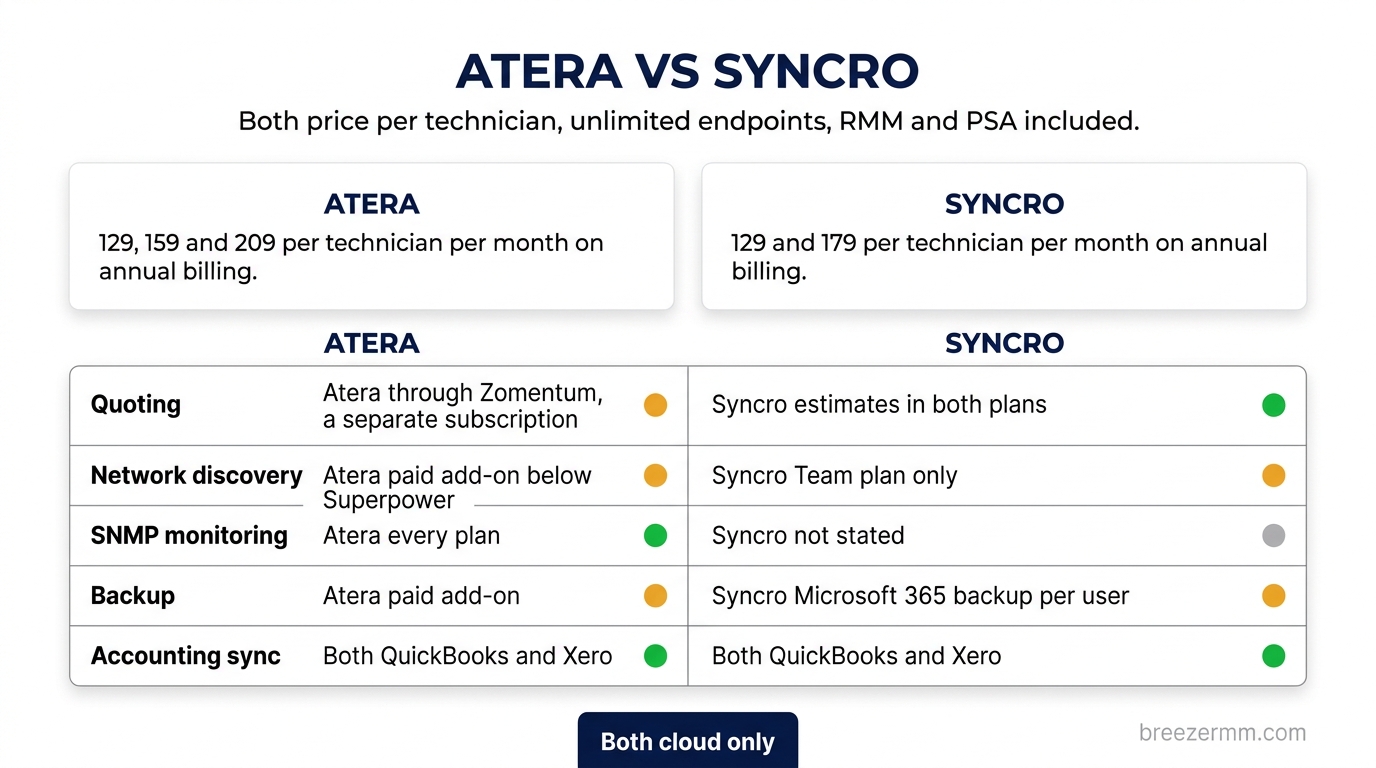
Atera and Syncro are the two products most small MSPs end up choosing between, because they make the same promise: one per-technician price, unlimited endpoints, and the RMM and the PSA in the same product. On the pricing page they look almost identical. Atera Pro and Syncro Core are both $129 per technician per month on annual billing.
Here is the short version up front. Pick Syncro if you want quoting and recurring billing in the base plan, or if you plan to add privileged access management. Pick Atera if you want the AI assistant in every plan, SNMP monitoring without an upgrade, or a middle tier between the entry plan and the top one. The rest of this post is the detail behind that, with every figure tied to a source.
A disclosure before the detail: this blog is published by Breeze, an RMM and PSA vendor that competes with both products. The prices below were read from each vendor’s own pricing page in November 2026, and the contract ratings come from our 2026 RMM pricing index. Vendors change pricing without notice, so confirm current numbers before you budget.
Pricing: the same model, almost the same price
Both vendors charge per technician and do not cap endpoints. That makes them cheap per endpoint for a lean team with a large fleet, and expensive per endpoint for a solo technician with a small one. One Atera Pro seat covering 50 endpoints works out to $2.58 per endpoint, and the same arithmetic applies to Syncro Core, because the rate is the same.
Atera has three published plans. On annual billing, Pro is $129, Growth is $159, and Power is $209 per technician per month. Billed monthly, the same plans are $139, $189, and $249. The plan-by-plan detail is on our Atera pricing page.
Syncro has two. Core is $129 per technician per month on annual billing, or $159 billed monthly. Team is $179 on annual billing, or $209 billed monthly. Its pricing page offers a 14-day free trial with no credit card and says to ask about volume discounts and multi-year terms. The detail is on our Syncro pricing page.
So the entry plans cost the same, and the difference appears one step up. Atera Growth is $159 and Syncro Team is $179. Here is what that means per year at the team sizes our index models, on annual billing. Each figure is the monthly rate times the number of technicians times 12.
| Team | Atera Pro or Syncro Core | Atera Growth | Syncro Team |
|---|---|---|---|
| 50 endpoints, 1 technician | $1,548 | $1,908 | $2,148 |
| 250 endpoints, 3 technicians | $4,644 | $5,724 | $6,444 |
| 1,000 endpoints, 8 technicians | $12,384 | $15,264 | $17,184 |
| 5,000 endpoints, 20 technicians | $30,960 | $38,160 | $42,960 |
| 10,000 endpoints, 40 technicians | $61,920 | $76,320 | $85,920 |
These are license costs only. What matters more is what each plan includes, because the two vendors draw the line between base plan and upgrade in different places.
Contract terms and lock-in
There is little to separate them here, and that is good news. Both offer monthly or annual billing, with the lower rate on annual. Our pricing index rates both Low for lock-in risk, and it did not document auto-renewal ratchets, committed minimum quantities, or early termination penalties of the kind found in the quote-only vendors’ agreements.
Neither caps endpoints, so there is no overage math when a client adds machines. The index says of Syncro that what you see on the pricing page is what you pay.
Features: where they actually differ
Both platforms are cloud only, and both have established QuickBooks and Xero sync. The differences are in six places.
Quoting. This is the clearest gap. Syncro includes estimates in both plans. Its pricing page says estimates, invoicing, payments and recurring billing automation are included in Core and Team. Atera has no native quoting that we could find in its help center. It offers Zomentum through its App Center, as a separate subscription that Atera bills for. If you quote often, price that subscription into the Atera side.
Agreements and recurring billing. Both have it. Atera’s billing module uses retainer and flat-fee contracts for monthly or recurring billing. Syncro lists recurring billing automation in both plans.
Network monitoring. Atera includes its SNMP module in every subscription at no extra charge. Network Discovery is a different matter: its help center says it is included with the Superpower plan and is an optional paid add-on on the other plans. Syncro puts Network Discovery on the Team plan and not on Core. Either way, discovery costs more than the entry price.
Privileged access management. Neither builds it. Syncro offers it through AutoElevate, and its documentation says usage is billed in arrears on your Syncro invoice. Syncro does not publish that price. Atera’s help center does not list an elevation feature at all, so on Atera you would buy and manage a separate tool.
AI. Atera includes its AI Copilot in every plan. Robin, its autonomous agent, is a separate paid add-on. Syncro puts its AI capabilities on the Team plan, and its pricing page says they are free through January 2027. Syncro has not published what they cost after that, so ask before you build a process around them.
Backup. It costs extra on both. Our index lists backup as a paid add-on for Atera. Syncro sells Microsoft 365 Cloud Backup at $1.90 per user per month, which scales with mailboxes and not with managed devices.
Head-to-head at a glance
| Dimension | Atera | Syncro |
|---|---|---|
| Pricing model | Per technician, unlimited endpoints | Per technician, unlimited endpoints |
| Published price, annual billing | $129, $159 and $209 per technician per month | $129 and $179 per technician per month |
| Published price, monthly billing | $139, $189 and $249 | $159 and $209 |
| Lock-in risk (index rating) | Low | Low |
| PSA | Included, with helpdesk and billing | Included in every plan |
| Quoting | Through Zomentum, a separate subscription | Estimates in both plans |
| Recurring billing | Contracts in the billing module | Recurring billing automation in both plans |
| SNMP monitoring | In every subscription | Not stated on the pricing page |
| Network discovery | Paid add-on below the Superpower plan | Team plan only |
| Privileged access management | Not listed | Through AutoElevate, billed separately |
| AI | Copilot in every plan. Robin is a paid add-on | On the Team plan, free through January 2027 |
| Backup | Paid add-on | Microsoft 365 backup at $1.90 per user per month |
| Accounting sync | QuickBooks and Xero | QuickBooks and Xero |
| Deployment | Cloud only | Cloud only |
For the same comparison across every vendor, the tables in our best RMM software guide show what each price covers, and best PSA software covers the PSA side on its own.
Which should you choose?
You send quotes every week. Syncro. Estimates are in the base plan, and on Atera quoting is a second subscription.
You want an AI assistant without paying for the higher plan. Atera. Copilot is in every plan, including Pro.
You plan to remove local admin rights from client machines. Syncro has a path for it through AutoElevate, on one invoice. On Atera you are sourcing that yourself.
You monitor a lot of switches, firewalls and printers. Atera, for SNMP in every plan. If you also need discovery of unmanaged devices, compare Atera’s add-on price with the step up to Syncro Team.
You want something between the entry plan and the top one. Atera has a middle plan, Growth, and Syncro goes straight from Core to Team.
You are a solo technician with a small fleet. Neither model favors you. At 50 endpoints a per-technician seat is a high price per endpoint on both. Check a per-endpoint vendor too.
If you are leaving one of them, our lists of Atera alternatives and Syncro alternatives line up the rest of the market against each.
Where Breeze fits
Full disclosure, this is our product, so weigh accordingly. Breeze is an open-source RMM with a built-in PSA, licensed under AGPL-3.0. It does not meter the technician. The self-hosted Community edition is free with unlimited devices and technicians, and it includes quoting, recurring contracts, SNMP monitoring, network discovery and privileged access management for Windows, along with the workers, its built-in AI. If you would prefer not to run a server, Breeze Cloud is a hosted plan priced per device, with the rate published on the pricing page.
The honest caveats: Breeze is younger than either product, and its PSA syncs with QuickBooks Online only, where Atera and Syncro both sync with QuickBooks and Xero. Because Breeze Cloud is priced per device, a team where each technician manages a large fleet will pay less on Atera or Syncro. The detailed head-to-heads are on Breeze vs Atera and Breeze vs Syncro.
Bottom line
Atera and Syncro cost the same at the entry plan, so the price is not what should decide it. Pick Syncro if quoting, recurring billing and a route to privileged access management matter most. Pick Atera if you want the AI assistant and SNMP monitoring in every plan, or a middle tier to grow into. Both have light contract terms, so neither choice traps you. Before you sign, list the add-ons you would actually use on each side, price them, and compare the totals instead of the two entry prices.
Run Breeze on your own fleet
Start the Cloud Beta in minutes, or deploy for free with Docker Compose.