The IT platform that comes with the workers.
The workers are Breeze’s built-in AI. They triage alerts, patch fleets and resolve tickets, then quote, bill and invoice the work. You decide what runs on its own and what waits for your approval. Wisp is your next hire: one per operator, it runs their day.
20 minutes, no deck · US & EU regions live · See it fix a real issue →

The core is open source. Self-host Community free with unlimited devices and technicians. Read and fork the AGPL-3.0 core. Extensions under ee/ (Wisp and Breeze AI for Office) have separate commercial terms.
Your RMM runs what you scripted. The workers work out the rest.
Your RMM today
It runs what you scripted
- ALERT
An alert fires and waits in the queue until someone gets to it.
- CONTEXT
You jump between the RMM, the PSA and email to piece together what happened.
- DIAGNOSE
You read the logs and work out the root cause.
- REMEDIATE
You run the fix, or the script you wrote for last time.
- DOCUMENT
You write up the ticket afterward, if there is time.
Five jobs. All yours.
Breeze
The workers do the work
- ALERT
An alert fires. The workers pick it up.
- CONTEXT
They gather device state, logs, and history on their own.
- DIAGNOSE
They isolate root cause and check it against known fixes.
- REMEDIATE
They apply the fix. Tier 3 steps wait for your approval.
- DOCUMENT
They document the resolution as the work happens.
Five jobs. The workers do them.
Watch the workers work an incident, start to finish.
One alert, start to finish. The workers investigate, propose the fix and wait for your approval before anything changes.
CPU pegged at 97%
A workstation at a law firm crawls. The alert fires and the workers pick it up.
Root cause found
The Print Spooler is stuck on one corrupt job from the second-floor copier.
Fix proposed, you approve
The workers propose a spooler restart and wait. Every step is logged, and the fix is remembered.
Real screenshots · demo data · click through it yourself
5 steps
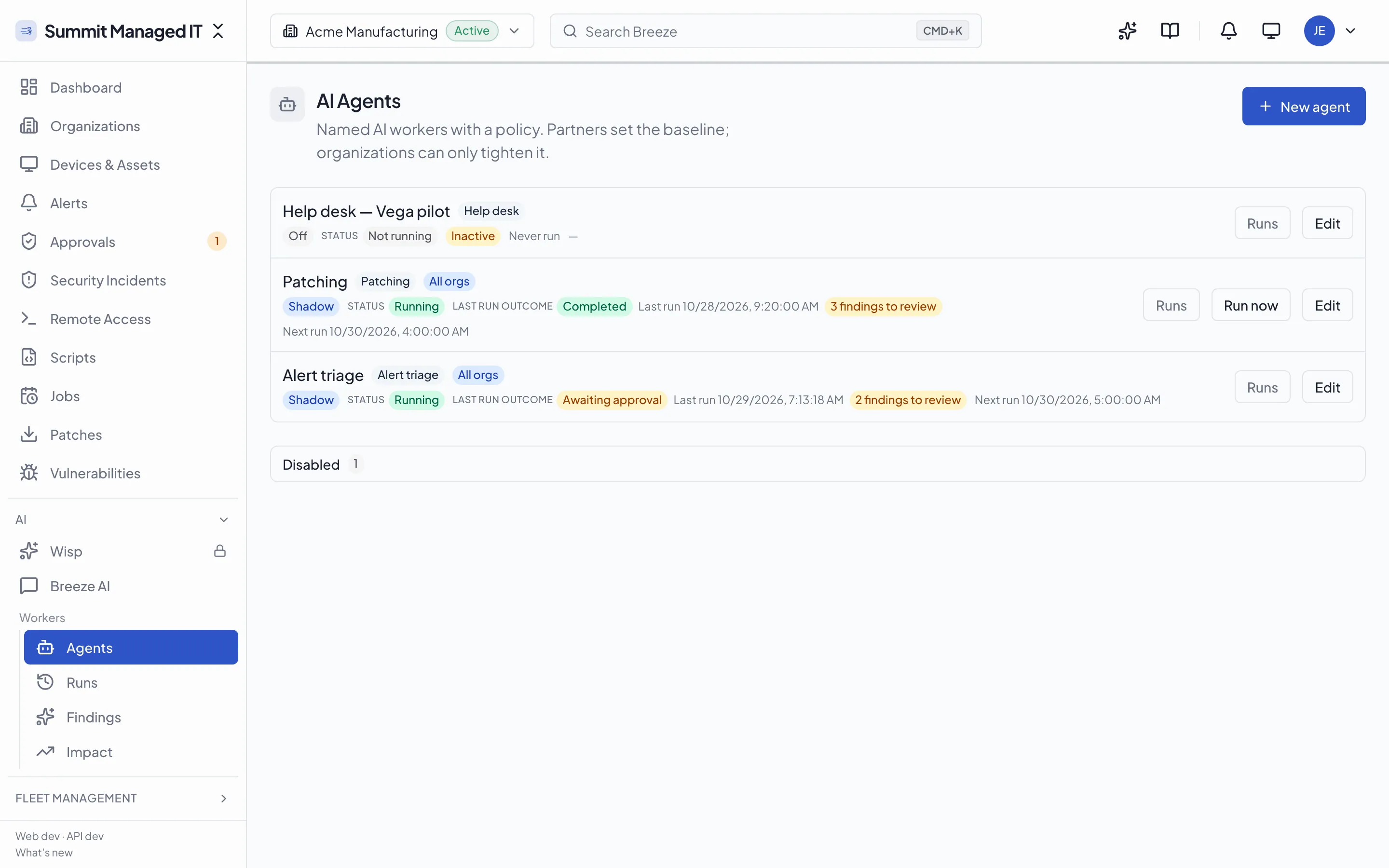
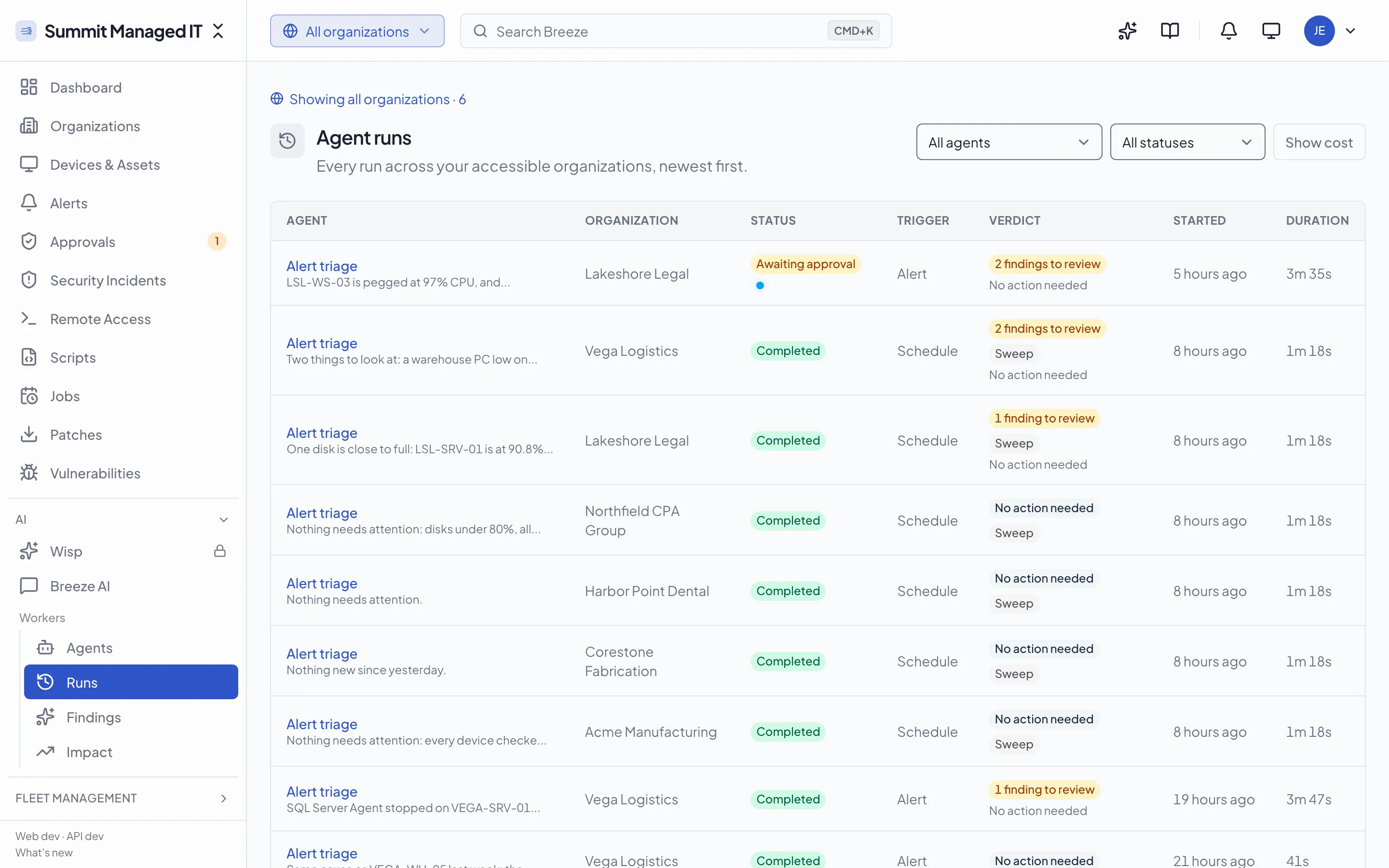
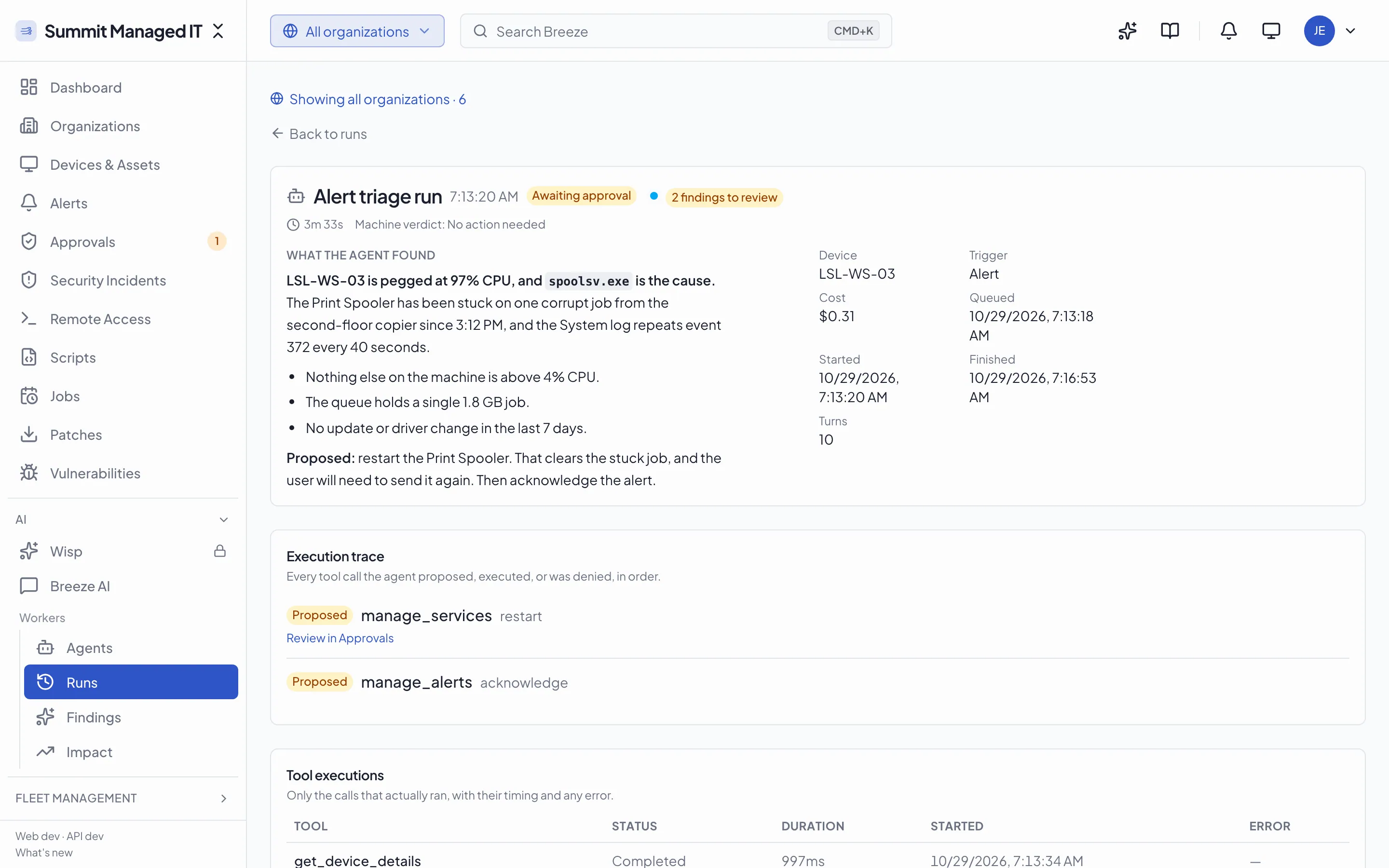
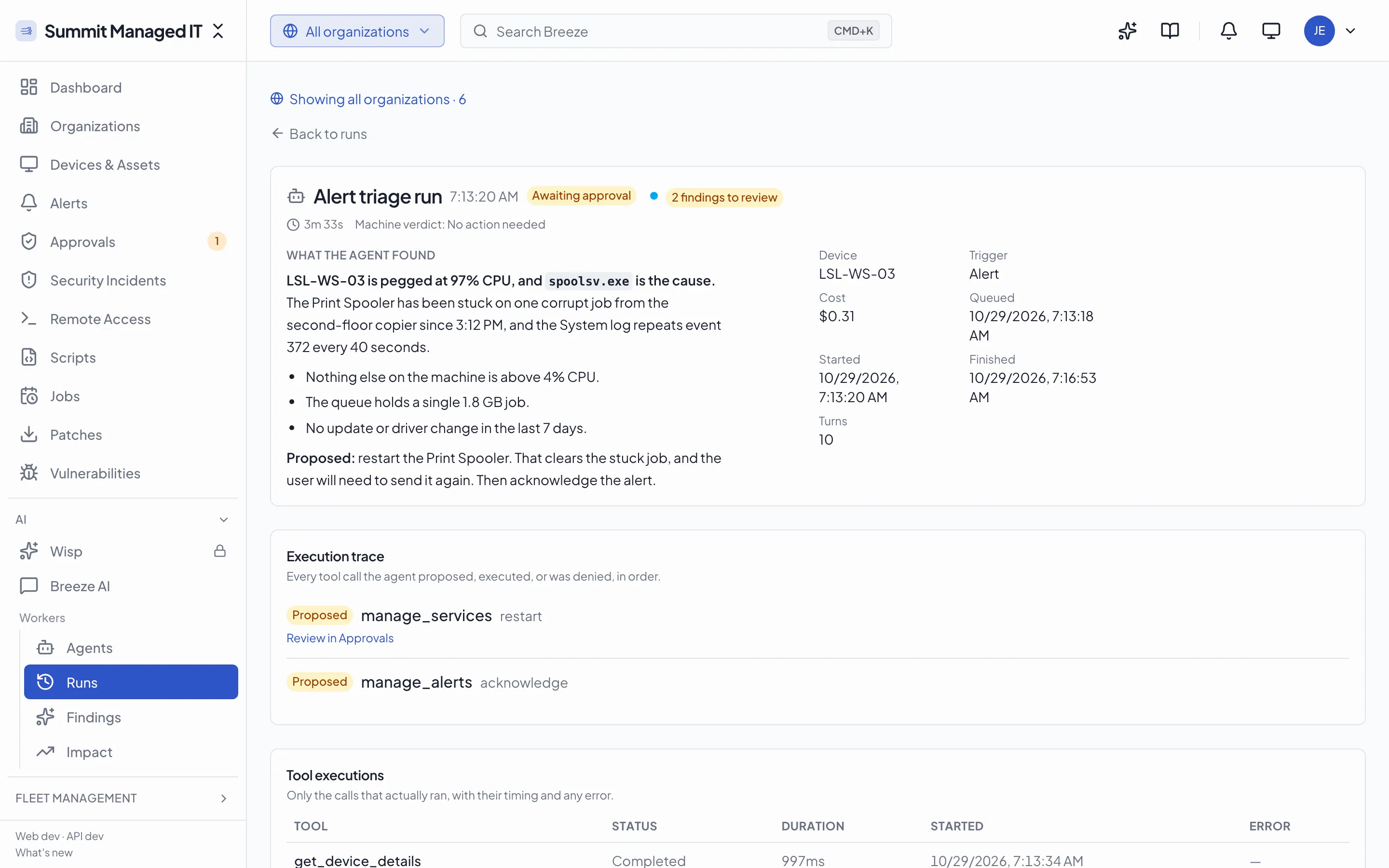
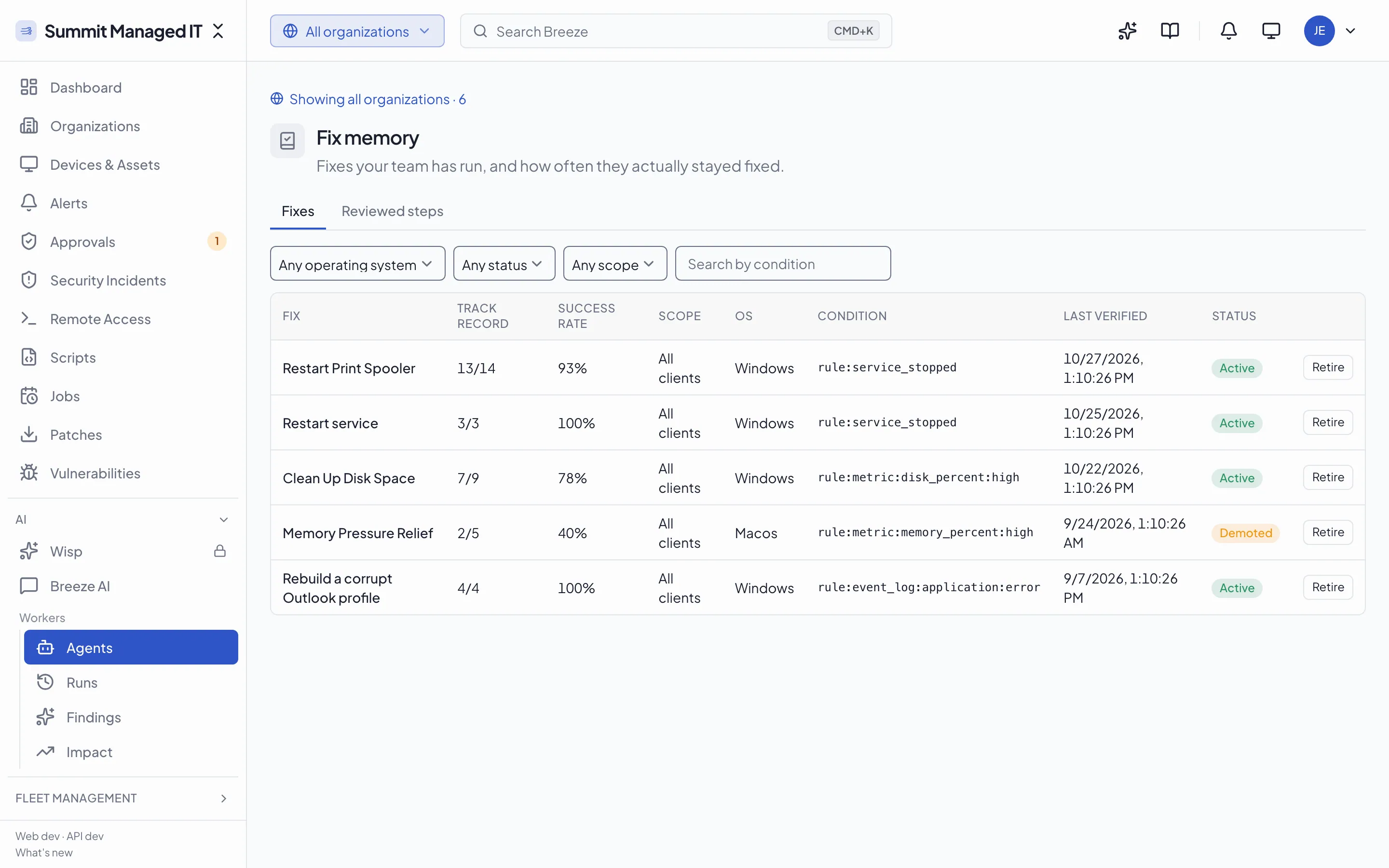
Screenshots from Breeze v0.125.0, captured 2026-10-29, on demo data.
Prefer a recording? Watch the workers find a runaway process on a live Linux server (2:19, real model, one approval), or browse all 38 walkthrough videos.
Resolved is nice. Invoiced is better.
Fixing the issue is half the job. The other half (the time entry, the quote, the invoice) is where the margin leaks. Breeze closes the loop in one system.
Ticket lands
An end-user reports it, or an alert becomes a ticket. Either way it enters the same queue.
The workers take it
Triage, investigation and the fix, within the risk tiers you set.
Time lands on the ticket
Work is recorded as it happens: time entries and parts, with billable status.
Quote drafted from the catalog
Follow-up work gets quoted from your real catalog at your real prices, as a proposal.
You approve from your pocket
One tap. Everything around it is already done.
Invoice goes out
Generated from the same record the work created. Nothing re-keyed, nothing dropped at a sync seam.
LoopAt every other vendor this is two products from two companies, glued by a sync job. In Breeze it's one system: see the PSA side of the platform →
They act. You hold the controls.
The workers act on their own for the safe things and stop for the rest. You decide where that line sits.
Four risk tiers
Tiers read the context. A reboot inside a maintenance window is Tier 2; the same reboot outside one waits as Tier 3. Nothing approves itself on a timer: if nobody reviews a Tier 3 action, it never runs.
Same rules, every path
The dashboard, your AI client, and a scheduled script all clear the same governance. There is no side door.
Audit parity
Every action logs identically (tool, parameters, who asked, which client, outcome), whether it came from the dashboard, Claude Desktop, or a script.
Scoped keys
A read-only key cannot escalate to running scripts, no matter which client is asking. Revoke any AI client in one click.
Client isolation
A key issued for one client cannot see or touch another. Enforced on every call.
Not a mockup. A real Tier 3 approval, verified with a passkey, in the actual product.
Give every person on your team a Wisp.
Run the workers yourself, free, on your own key. Or give each person on your team a Wisp: the hire that watches their customers all day, brings one subject and one next step, asks before anything consequential, and never acts above their authority.
- Watches continuously, not once a morning
- One nudge, one next step, on the right phone
- Your authority is the ceiling, and every action is in the audit log
Wisp
for Sam, Tuesday 7:30 am
Needs you · Greenwood
Backup failed twice overnight. The storage credential was rotated Monday. Re-run with the new credential?
Logged as “Wisp, for Sam”.
Everything the workers can reach.
Patching, scripts, monitoring, backups, network discovery and remote access in one platform, with the ticket, the quote and the invoice in the same system.
64 modules, one platform
The Workers
The workers: Breeze's built-in AI that acts safely across your fleet.
Included · No Add-OnAI for Your Clients/Users
Your clients get AI from you, not from shadow ChatGPT.
Only in BreezeAI Risk Engine
Control what AI can do, when, and under whose approval.
Device Management
Know what is running, what is drifting, and what needs action.
Remote Access
Connect to endpoints securely from a single web interface.
Automations
Turn recurring operations into governed workflows.
Network Discovery & Trust
Map the network and control device trust boundaries.
Patch Management
Run patching as a controlled lifecycle, not a one-off task.
Run it from the AI tools your team already lives in.
The workers work the fleet from inside the console, but their tools aren't locked in there. Breeze was the first RMM to ship an MCP server, so your own AI client can pick up the exact same governed tools.
Your AI client
Claude · Cursor · ChatGPT
MCP
17 governed tools
Breeze server
RBAC · risk tiers · audit
Fleet
devices under management
Connecting takes a single command, over OAuth or a scoped key. From there your AI client works the fleet directly: querying devices, triaging alerts, deploying patches, under the same risk tiers and audit log as the dashboard. A real session looks like this:
Works with
17 tools, one governed interface
Built for operators, not procurement.
Breeze isn't trying to be every team's RMM. It's built for the leader whose queue grows faster than their headcount, and honest about who it isn't for.
-
MSPs with two to twenty-five technicians. The queue grows faster than you can hire. The workers take the triage, the patching and the write-ups, and each person’s Wisp keeps their day to one next step.
-
IT teams serving 300 people or more. The headcount request gets denied while the ticket count climbs. You get the same platform with one organization and the help desk built in.
-
Teams leaving another RMM. Read the side-by-side before the call: Breeze vs Kaseya, Breeze vs NinjaOne, Breeze vs Datto RMM, Breeze vs ConnectWise.
Not the right fit
If you want a dedicated account rep, a 40-page MSA and a quarterly business review, the big vendors will serve you well. Breeze is for teams that want to see it work on their own fleet first.
Bring your queue to a 20-minute call.
We show you Breeze working and answer the questions that decide it: what the workers may touch, what moving off your current RMM takes, and what you would pay. No deck.
- Breeze Cloud
- Start by November 15: $99 a month for each 250 devices, a price held 12 months from your start date. After that, published pricing applies, or we agree a contract with you. 500 devices: $198 a month. Start on or after November 16: $4 a device a month. 500 devices: $2,000 a month. Every module, unlimited technicians.
- Wisp
- $249 per person a month, on Breeze Cloud.
- Self-hosted
- Free, forever. Deploy it with Docker Compose.
Start the Breeze Cloud beta
Already self-hosting? Let us run it for you. New to Breeze? Skip the infrastructure work.
Not in the US? Sign up for EU →
Month to month, cancel any month Add devices in 60s Direct team access
Having trouble? [email protected]