Best AI RMM Tools in 2026: An Honest Comparison for MSPs
Every RMM vendor now has an AI story. Search for the best AI RMM and you get a page of products whose “AI” ranges from a summarize button on a ticket to an autonomous agent that resolves issues on its own. Those are not the same product, they are not the same price, and they do not solve the same problem.
This guide sorts the field by what the AI actually does. One disclosure before we start: we build Breeze, one of the tools on this list. The fix for that bias is not pretending to be neutral. It’s giving you a test you can run against every vendor, including us.
The one question that sorts every AI RMM
When something breaks on the fleet, does the AI do the work, or does it describe the work for a human to do?
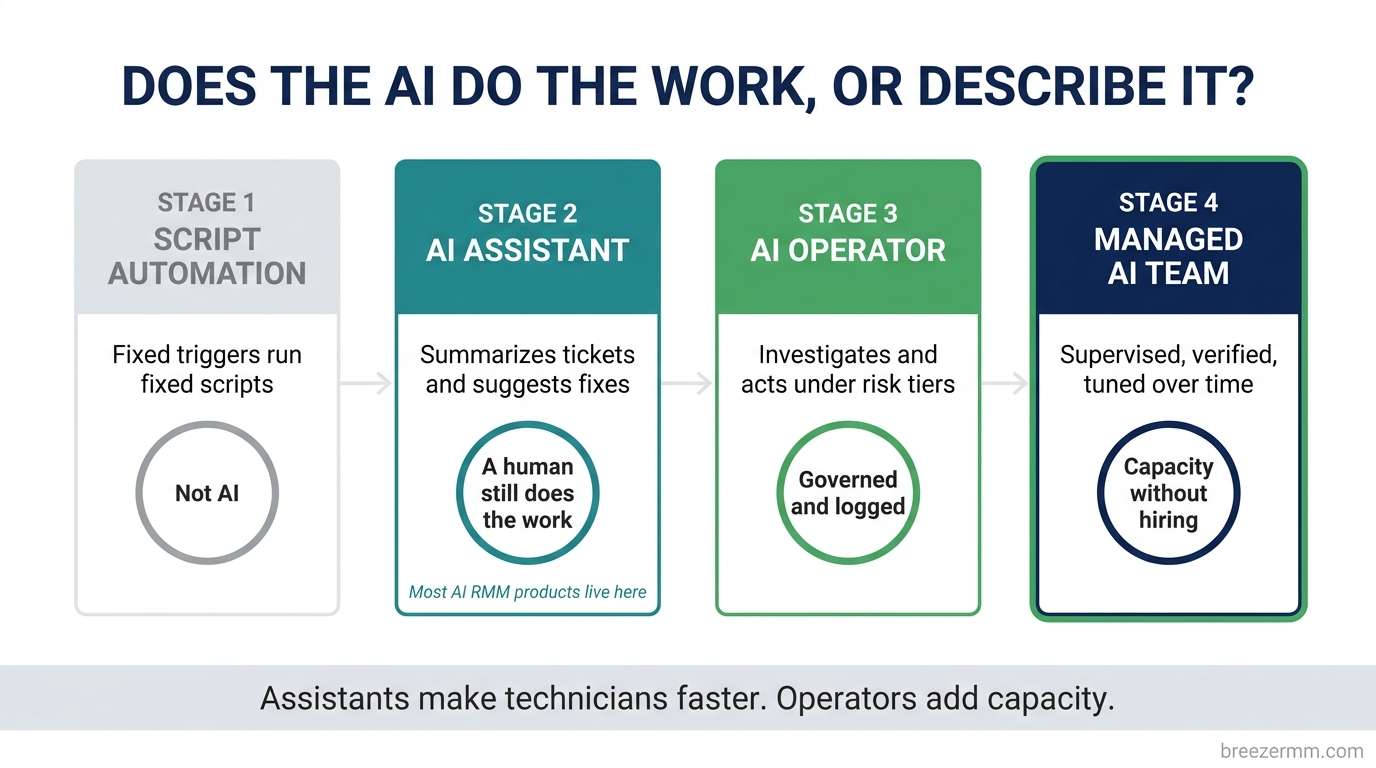
That question splits the market into four capability stages:
- Script automation. Fixed triggers run fixed scripts. Valuable, deterministic, and not AI, whatever the datasheet says.
- AI assistant. A chat or copilot layer that summarizes tickets, drafts scripts, and suggests fixes. A technician still does the work. Most “AI RMM” products live here.
- AI operator. AI with real tool access to the fleet: it investigates, then takes or proposes the fix, governed by risk tiers and logged for audit.
- Managed AI team. The operator plus supervision: someone reviews the AI’s work, verifies resolutions held, and tunes it over time.
Assistants make your existing team faster. Operators add capacity. That distinction matters more than any feature list, because an MSP’s constraint is rarely how fast a tech can read a ticket. It’s how many tickets the bench can absorb.
Here’s the field, sorted honestly.
Breeze (that’s us)
Stage: AI operator built in, managed AI team on the paid tier.
Breeze is an open source RMM and PSA in one platform, with an AI operator included free in every deployment, self-hosted or cloud. The operator investigates alerts and tickets, correlates signals across the fleet, and acts inside a four-tier risk engine: reads are free, low-risk reversible actions auto-execute with a log, impactful actions wait for human approval, and destructive actions are blocked outright. Every tool call is logged.
The paid flagship, Managed AI Ops, is the stage-4 layer: a team of AI agents working your queue, supervised and tuned by the people who built the platform. We read the AI’s ticket conversations, verify resolutions actually held, and adjust the agents as your fleet changes.
Honest limits: Breeze is young. The cloud tier is in beta, the managed offering runs as a curated design-partner motion, and we will not manufacture customer counts or testimonials to look bigger than we are. The core platform with 60+ modules is free to self-host, so the cheapest way to evaluate the claims on this page is to run it.
Fits: MSPs who want capacity without the next hire, and want the governance provable rather than promised.
Atera
Stage: AI assistant included, autonomous agent as a paid add-on.
Atera is the clearest AI pricing story among the incumbents, and credit where due. As of mid-2026, its AI Copilot assistant is included in every plan at no extra cost (per Atera’s support documentation, checked July 2026): it drafts scripts, summarizes tickets, and suggests fixes for a technician who is still doing the work. Robin, Atera’s autonomous agent that resolves end-user issues on its own, is a separate paid add-on billed per user on top of the subscription (per Atera’s AI FAQ, checked July 2026).
Read that pricing shape carefully: devices are unlimited, but the AI that actually reduces labor is metered per user. The platform is also proprietary and cloud-only, so there is no way to inspect how the AI is governed beyond what the vendor publishes. Plans run $129 to $209 per technician per month billed annually.
Fits: MSPs who want simple per-technician pricing with a capable assistant, and are comfortable paying per user for autonomy inside a closed platform. See our full Breeze vs Atera comparison.
SuperOps
Stage: AI assistant.
SuperOps combines PSA and RMM with an AI assistant called Monica, and leans on AI-assisted workflows across the product. Pricing is per technician ($109 to $179 per month on published tiers) with a cap on included endpoints per technician, expanded in 150-endpoint packs. The assistant framing is accurate here: the AI helps a technician work the queue rather than working the queue itself.
Fits: Newer MSPs who want a modern all-in-one platform and are optimizing for technician speed rather than added capacity.
Syncro
Stage: AI assistant.
Syncro’s AI features (ticket summarization, smart search, and guided resolution, per Syncro’s published AI documentation, checked July 2026) make technicians faster at working the queue they already have. By Syncro’s own documentation, the AI assists the technician; it doesn’t take the ticket off their plate. Pricing is per technician, $129 to $179 per month with unlimited endpoints, and its accounting integrations are more mature than most rivals’.
Fits: Small MSPs that live in the PSA side of the house and want assistant-level AI with clean per-tech pricing. Full Breeze vs Syncro comparison.
NinjaOne
Stage: AI assistant features on a strong traditional RMM.
NinjaOne is one of the best traditional RMMs on the market: excellent interface, solid automation through scripting and policies, and per-device pricing that roughly ranges from $3.75 per device per month at small fleets down toward $1.50 at very large ones. It has been shipping AI features, but it has not published a governance framework for AI action on fleets: no public risk-tier model, no documented approval flow for autonomous fixes. Until that exists, evaluate it as an outstanding dashboard with assistant features, where the labor model is unchanged: alerts surface, and your technician works them.
Fits: MSPs who want a polished, proven RMM today and are not yet buying the AI layer. Full Breeze vs NinjaOne comparison.
ConnectWise
Stage: AI assistant features across a legacy suite.
ConnectWise has shipped AI features, mostly summarization and copilots, on top of a long-established codebase spread across Automate, RMM, and Manage. There is no unified, tool-using AI operator with built-in risk classification and human-in-the-loop approvals. Pricing combines per-device fees, per-technician licenses, and add-ons, generally negotiated annually with no public list prices.
Fits: Established MSPs already deep in the ConnectWise ecosystem. Full Breeze vs ConnectWise comparison.
Kaseya / Datto RMM
Stage: AI assistant features across the suite.
Kaseya’s platforms (VSA, Datto RMM, Kaseya 365) include assistant-style AI features, but no governed autonomous operator with a published risk engine. The bigger evaluation issue is contractual: as of mid-2026 there are no public list prices, subscriptions auto-renew for the committed term unless cancelled in writing, quantities can’t drop below your committed minimum even when clients churn, and early termination accelerates the remaining fees. Whatever the AI does, model the exit cost first.
Fits: MSPs committed to the Kaseya bundle economics who go in with eyes open on terms. Full Breeze vs Kaseya and Breeze vs Datto RMM comparisons.
The DIY route: open source RMM plus your own AI
Stage: whatever you build, which is the problem.
Tactical RMM and MeshCentral are capable free tools with no AI layer: automation is scripts and scheduled tasks, driven by hand. You can wire a chat model to their APIs yourself, but then you own everything a vendor would: the governance model, the failure analysis, the audit trail, and the prompt tuning. You did not adopt AI; you became an unpaid AI vendor with one customer.
If you want the self-hosted, inspect-the-source route with the AI layer already governed, that is exactly the gap Breeze’s open source platform exists to fill: the operator and the risk engine ship in the free deployment.
Fits: Teams with the engineering bench to run infrastructure, who should still refuse to hand-roll AI governance.
The checklist, whoever you pick
Whatever vendor you evaluate, the full AI RMM buyer’s checklist is five items, and none are optional: a risk-tiered governance model, a complete audit trail of every AI action, human approval on impactful actions, supervision of the AI’s work quality over time, and an RMM that keeps working with the AI switched off. Ask every vendor to show you the approval flow on a live fleet. If they show you a highlight reel instead, you have your answer.
The honest bottom line: if you want your current team to move faster, the assistants from Atera, Syncro, and SuperOps are real features at clear prices. If you want work taken off the queue, you need an operator under governance, and that category is still young. Ours is free to run, open to inspect, and the managed tier puts accountable humans behind it. Hold us to the checklist too.
Run Breeze on your own fleet
Start the Cloud Beta in minutes, or deploy for free with Docker Compose.