The True Cost of RMM in 2026: Annual Pricing Index
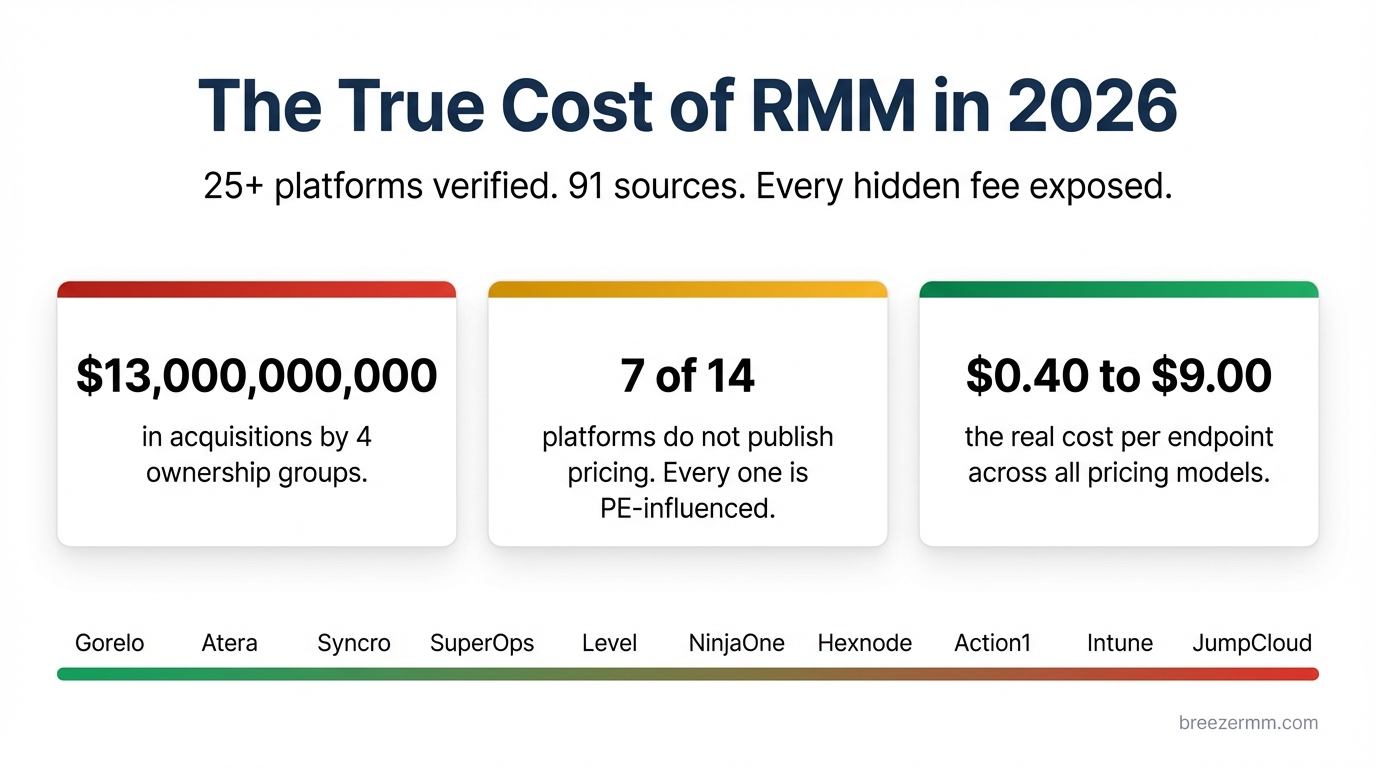
TL;DR — We verified pricing for 25+ RMM platforms across 91 sources. Here is what we found: the cheapest transparent option at 1,000 endpoints is $9,504/year (Gorelo), the most expensive is $108,000/year (JumpCloud). Per-technician pricing (Atera, Syncro, Gorelo) beats per-endpoint pricing at scale — effective cost drops to $0.40–$0.52/endpoint at 10,000 endpoints. Seven of fourteen platforms do not publish pricing; every one is PE-owned. Over $13 billion in acquisitions have consolidated the market under four ownership groups, and the contract terms — 100% early termination fees, 80% overage ratchets, no mid-term downsizing — reflect it. Self-hosting is not free either: labor is 94–95% of the cost. The full data, every hidden fee, and TCO tables at five MSP sizes are below.
Your tool stack is the largest operating expense after payroll. For a typical MSP running 1,000 endpoints, the combined cost of RMM, PSA, backup, security, and documentation tools runs $8,000 to $15,000 per month. The RMM platform sits at the center of that stack, and it is the one cost that touches every other cost — because if the RMM cannot do something, you bolt on another tool that can.
The problem is that figuring out what RMM actually costs has become deliberately difficult. Seven of the top ten RMM platforms by market share do not publish pricing. You fill out a form, wait for a sales call, sit through a demo you did not ask for, and eventually get a quote that expires in 30 days and comes with a three-year commitment buried in the terms. The opacity is not accidental. It is a strategy. When buyers cannot compare prices, sellers do not have to compete on them.
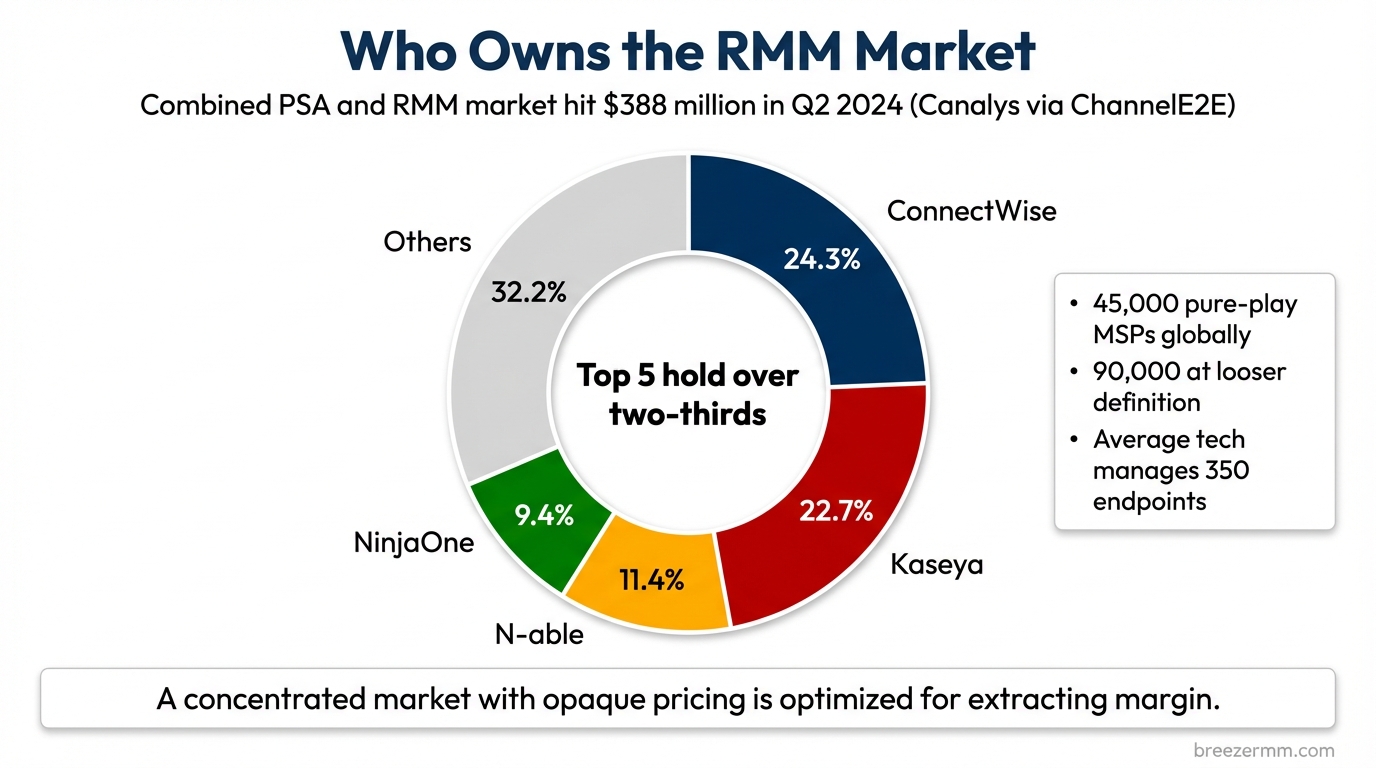
That strategy exists because the RMM market is no longer run by the people who built the products. Over the past decade, more than $13 billion in acquisitions have consolidated the MSP tool landscape under three or four private equity firms. Kaseya acquired Datto for $6.2 billion. Thoma Bravo took ConnectWise private. N-able was spun out of SolarWinds. The combined PSA and RMM market hit $388 million in Q2 2024 alone, per Canalys via ChannelE2E, and the top five vendors — ConnectWise at 24.3%, Kaseya at 22.7%, N-able at 11.4%, NinjaOne at 9.4%, and Syncro rounding out the group — hold more than two-thirds of the market. There are roughly 45,000 pure-play MSPs globally, closer to 90,000 at a looser definition, and the average technician manages around 350 fully managed endpoints. The math is straightforward: a concentrated market with captive buyers and opaque pricing is a market optimized for extracting margin, not delivering value.
This report exists because the data should be in one place. We verified pricing for 25+ RMM platforms, documented the hidden costs that do not appear on pricing pages — onboarding fees, minimum commitments, per-feature add-ons, overage charges — and calculated total cost of ownership at real MSP scale: 250 endpoints, 1,000 endpoints, and 5,000 endpoints. Every platform profile includes acquisition context so you know who actually owns the product and what financial incentives are driving the roadmap.
Methodology. Sources include official pricing pages (linked), published contract terms, G2 and Capterra review data, r/msp community reports, vendor earnings calls, and direct verification where public data was unavailable. Ninety-one sources total. All data verified as of April 2026. Where a vendor does not publish pricing, we note that explicitly and provide the best available community-reported figures with clear attribution.
This is a living document. Last updated: April 2026. If you spot an error or have contract data that improves the accuracy of a listing, send it over — corrections are welcome and will be credited.
ConnectWise Automate & ConnectWise RMM
Thoma Bravo. Acquired 2019 for ~$1.5B. ~110 positions cut on deal announcement.
Ownership & History. Thoma Bravo acquired ConnectWise in 2019. The company now operates two separate RMM products: Automate, the legacy on-premise-roots platform, and ConnectWise RMM, the former Continuum product rebranded after acquisition. In 2024, ConnectWise acquired Axcient and SkyKick to expand its backup and cloud migration portfolio. CEO Jason Magee was replaced by Manny Rivelo in September 2024.
Pricing. ConnectWise does not publish per-endpoint pricing for Automate or ConnectWise RMM. Both require a sales conversation. Companion product ScreenConnect (remote access) does publish pricing: $33.60/month for a single-session license, $52.90/month for three sessions, and $0.60/endpoint/month for unattended access. Trial agents auto-convert to paid if not removed before the trial period ends. There is no public bundle calculator for combined Manage + Automate + ScreenConnect pricing.
Hidden costs. The following are sourced from ConnectWise’s published commercial terms and carry high confidence:
- Auto-renewal. Subscriptions auto-renew for periods equal to the expiring term or one year, whichever is shorter. Cancellation requires written non-renewal notice at least 60 days before the end of the current term. Missing the window locks you into another full term at the renewal price.
- Price increases at renewal. Per-unit pricing may increase at renewal. Promotional pricing increases at renewal. Renewal shock is possible even when the number of endpoints and scope of service are unchanged.
- No mid-term downsizing. Quantities cannot be decreased during a contract term. An MSP that loses a client mid-year cannot reduce its licensed endpoint count until the next renewal.
- Non-cancellable, non-refundable fees. All fees are non-cancellable and non-refundable once the contract begins. Exiting early means paying for the remainder of the term.
- Professional services. Scripts, connectors, and customizations may require paid professional services engagements. The real implementation cost can exceed the software quote.
- Training requirements. Administrators may need to complete ConnectWise University coursework to unlock certain support paths.
Community sentiment. ConnectWise Automate holds a 4.2/5 overall rating on Capterra with a 3.7/5 for customer service and a 5.8/10 likelihood to recommend. Posts on r/msp describe recurring 10–12% annual price increases and a decline in support quality following the Thoma Bravo acquisition.
TCO. Quote required. Total cost of ownership cannot be calculated without direct sales engagement.
Sources: ConnectWise Automate, ScreenConnect Pricing, ConnectWise Commercial Terms
Kaseya VSA & Datto RMM
Kaseya (Insight Partners). Datto acquired 2022 for $6.2B. 18 acquisitions over ~10 years.
Ownership & History. Kaseya is backed by Insight Partners and has executed 18 acquisitions over roughly a decade, including Vonahi, Graphus, audIT, Arcode, and SaaS Alerts. The $6.2 billion Datto acquisition in 2022 brought Datto RMM, Autotask PSA, and the BCDR portfolio under the Kaseya umbrella. The current go-to-market strategy centers on IT Complete and the Kaseya 365 Endpoint bundle, which packages RMM, endpoint security, and backup into a single per-endpoint price.
Pricing. Both Kaseya VSA and Datto RMM are quote-only. Kaseya 365 Endpoint is the bundle that sales teams push. Datto ended its high-water-mark billing model in December 2025 and moved to a Committed Minimum Quantity (CMQ) plus variable consumption model.
Hidden costs. The following are sourced from the Kaseya Master Agreement and Datto help documentation and carry high confidence:
- Auto-renewal. Subscriptions auto-renew for the same committed term and quantity unless cancelled in writing before the renewal date.
- Early termination acceleration. Terminating during a committed term accelerates 100% of remaining fees. The full remaining contract value becomes due immediately. This is one of the highest lock-in costs in the RMM market.
- Committed Minimum Quantity (CMQ). Quantities may increase during a term but cannot decrease below the committed minimum. Losing endpoints due to client churn does not reduce the base bill until the next renewal negotiation.
- Billing model transition. Datto RMM ended high-water-mark billing in December 2025 and moved to CMQ plus variable consumption. Customers who relied on elastic billing — where the count adjusted automatically each month — may face higher committed floors under the new model.
- Auto-added licenses. Datto RMM, Advanced Software Management, and Ransomware Detection licenses can be automatically added when usage triggers certain thresholds. Features you did not explicitly purchase can silently push invoices up.
- Bundle pressure. Kaseya 365 Endpoint is the primary sales motion. Individual components can still be purchased standalone, but pricing is structured to make standalone purchases economically unfavorable compared to the bundle.
Community sentiment. Datto RMM holds a 4.3/5 overall on Capterra with a 4.0/5 for customer service and a 6.5/10 likelihood to recommend. Kaseya VSA sits at 4.0/5 overall, 3.6/5 for service, and 5.9/10 likelihood to recommend. Reports on r/msp describe 5–8% renewal increases and sales pressure toward multi-year commitments.
TCO. Quote required.
Sources: Datto RMM Pricing, Kaseya Master Agreement, Datto CMQ Billing FAQ
N-able N-central & N-sight
Spun off from SolarWinds July 2021. Public company (NYSE: NABL). Adlumin acquired for up to $266M (2024).
Ownership & History. N-able was spun off from SolarWinds in July 2021, a move that carried the context of the SolarWinds supply-chain breach. The company trades publicly on NYSE under the ticker NABL, with Silver Lake and Thoma Bravo among its investors. Its market cap has declined from approximately $2.5 billion at spin-off to a share price of $4.66 as of March 2026. In 2024, N-able acquired Adlumin for up to $266 million ($220M cash, $16M stock, $30M earn-out). The company explored a sale in May 2024 but ultimately stayed independent. N-able operates two RMM products: N-central for enterprise and mid-market MSPs, and N-sight for SMB-focused operations.
Pricing. Both N-central and N-sight are quote-only. No public per-endpoint pricing is available.
Hidden costs. The following are sourced from the N-able Software Subscription Agreement (2025) and carry high confidence:
- Renewal commitment ratchet. At renewal, the new commitment is set to the prior commitment plus 80% of any usage above that commitment during the previous term. Short-term growth in one year becomes locked-in spend for the next. An MSP that temporarily scales up for a project and then scales back down will still carry the higher commitment forward.
- Annual-only commitment changes. Commitment levels can only be adjusted once per year at renewal. Mid-year reductions are not permitted. Client churn or endpoint losses during the year do not lower spend until the next renewal cycle.
- Multi-year commitment pressure. Reports on r/msp describe forced one- to three-year commitments and confirm the 80% overage roll-in at renewal.
Community sentiment. N-central holds a 4.1/5 overall on Capterra. Pricing transparency is rated lower than newer competitors that publish per-endpoint rates.
TCO. Quote required.
Source: N-able Software Subscription Agreement (2025)
NinjaOne
Private. $5B valuation. $500M+ ARR. ~70% YoY growth. Audi F1 sponsor (2026).
Ownership & History. NinjaOne is a private company with $783 million in total funding. Its most recent round — a $500 million Series C extension in February 2025 — was led by ICONIQ Growth and CapitalG (Alphabet’s investment fund) and valued the company at $5 billion. NinjaOne holds 9.4% market share as of Q2 2024 per Canalys, making it the fastest-growing vendor among the top five. The company has held the #1 position on G2 for 23 consecutive quarters and reported $500M+ ARR at the start of 2026 with approximately 70% year-over-year growth.
In January 2026, NinjaOne announced a multi-year partnership with the Audi Revolut F1 Team. NinjaOne is the team’s “Official Endpoint Management, Mobile Device Management, and SaaS Backup Partner” and manages endpoints and systems across factory and trackside operations globally. The sponsorship value has not been publicly disclosed. For context: per-endpoint fees paid by MSPs are funding an F1 sponsorship.
In June 2025, NinjaOne completed its acquisition of Dropsuite for approximately $270 million. Dropsuite’s SaaS backup product — covering Microsoft 365 and Google Workspace — has been rebranded to NinjaOne SaaS Backup. The acquisition adds a backup bundle revenue stream to the NinjaOne platform.
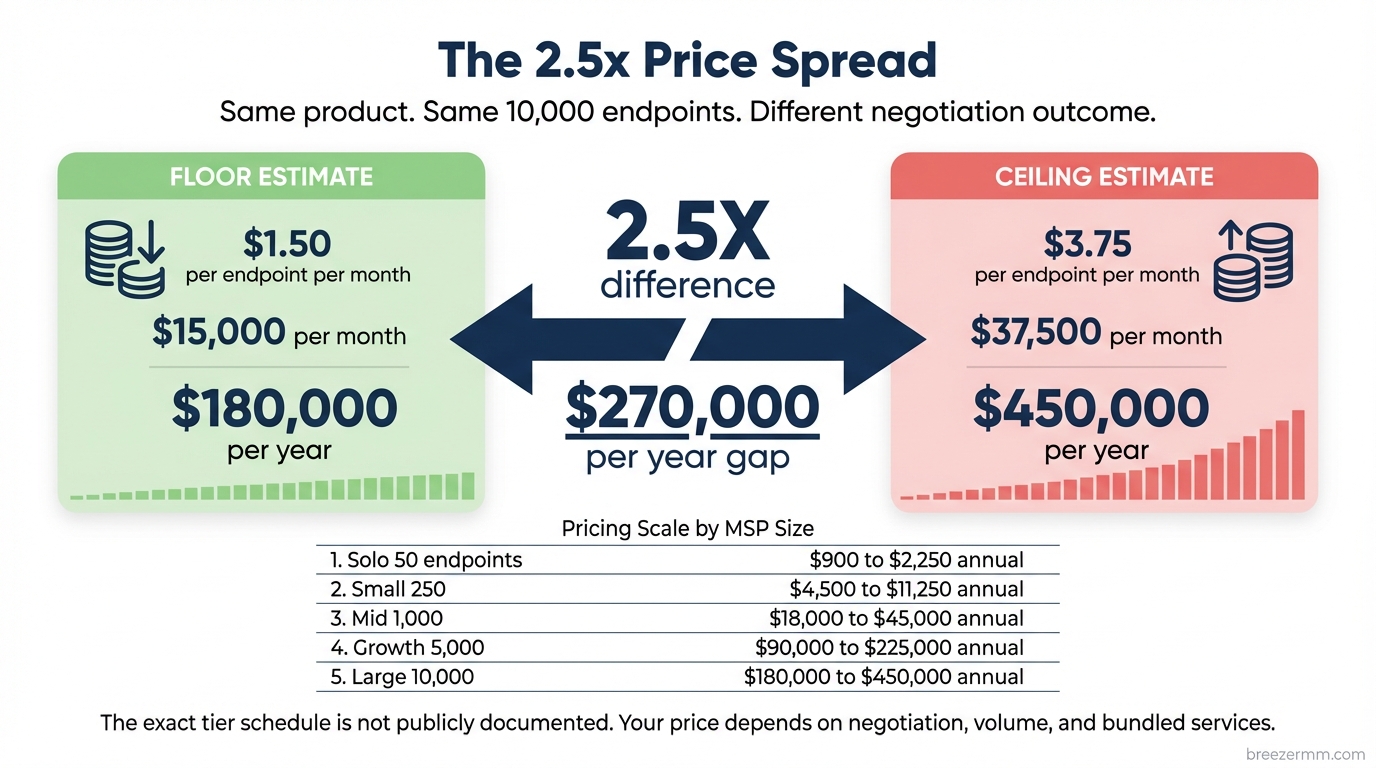
Pricing. NinjaOne publishes pricing ranges but does not post an exact tier schedule. Published benchmarks indicate approximately $3.75 per device per month at 50 endpoints or fewer, declining to approximately $1.50 per device per month at 10,000 endpoints. Onboarding and training are included at no additional cost. There are no maintenance fees. Customers not in a promotional commitment can cancel with 60 days’ notice. The official pricing page does not list a minimum; community anecdotes suggest some minimums exist depending on the sales conversation.
Confidence note: Medium. The per-endpoint range is sourced from NinjaOne’s published materials and community reports, but the exact tier schedule — how the price steps down between 50 and 10,000 endpoints — is not publicly documented as of April 2026.
TCO. Because the exact tier schedule is not public, total cost of ownership is presented as a range between the published floor ($1.50/device/month) and ceiling ($3.75/device/month):
| MSP Size | Endpoints | Monthly (floor) | Monthly (ceiling) | Annual (floor) | Annual (ceiling) |
|---|---|---|---|---|---|
| Solo | 50 | $75 | $188 | $900 | $2,250 |
| Small | 250 | $375 | $938 | $4,500 | $11,250 |
| Mid | 1,000 | $1,500 | $3,750 | $18,000 | $45,000 |
| Growth | 5,000 | $7,500 | $18,750 | $90,000 | $225,000 |
| Large | 10,000 | $15,000 | $37,500 | $180,000 | $450,000 |
The 2.5x spread between floor and ceiling is itself the story. At 10,000 endpoints, you could be paying $180,000 per year or $450,000 per year for the same product depending on negotiation, volume, and bundled services.
Sources: NinjaOne Pricing, NinjaOne $500M Series C Extension, NinjaOne x Audi F1 Partnership, NinjaOne Dropsuite Acquisition
Atera
Private. $500M valuation (2021). $182M total funding. Per-technician pricing pioneer.
Ownership & History. Atera pioneered the per-technician pricing model in the MSP RMM space. Rather than charging per endpoint, Atera charges a flat monthly rate per technician with no cap on the number of endpoints that technician can manage. The company raised $77 million in a Series B round in 2021 at a $500 million valuation, bringing total funding to $182 million. Atera has since added an AI Copilot feature across its tiers and positions itself as the all-in-one alternative to the legacy PSA-plus-RMM stack.
Pricing (High confidence):
| Plan | Monthly/tech | Annual-effective/tech | Includes |
|---|---|---|---|
| Pro | $159 | $129 | RMM, monitoring, alerts, PSA/helpdesk, billing, reporting |
| Growth | $209 | $179 | Adds advanced automation and analytics |
| Power | $249 | $209 | Higher-tier bundle with expanded capabilities |
| Superpower | Quote | Quote | Enterprise features, custom pricing |
No endpoint cap on any plan. Monthly or annual billing. AI Copilot availability and advanced capabilities vary by tier.
Hidden costs. The per-technician model has one structural cost that does not appear on the pricing page: at small scale, you are overpaying per endpoint. A solo technician managing 50 endpoints pays $2.58 per endpoint. A solo technician managing 200 endpoints pays $0.65 per endpoint. The economics only work if the technician-to-endpoint ratio is high. MSPs that staff conservatively — more techs per endpoint for better service — pay more than MSPs that run lean.
TCO at scale:
| MSP Size | Endpoints | Techs | Pro Monthly | Pro Annual | $/endpoint |
|---|---|---|---|---|---|
| Solo | 50 | 1 | $129 | $1,548 | $2.58 |
| Small | 250 | 3 | $387 | $4,644 | $1.55 |
| Mid | 1,000 | 8 | $1,032 | $12,384 | $1.03 |
| Growth | 5,000 | 20 | $2,580 | $30,960 | $0.52 |
| Large | 10,000 | 40 | $5,160 | $61,920 | $0.52 |
Per-technician pricing destroys per-endpoint pricing at scale. At 10,000 endpoints with 40 technicians, the effective cost is $0.52 per endpoint — cheaper than every per-endpoint vendor in this report. But the solo operator managing 50 endpoints pays $2.58 per endpoint, which is more expensive than several per-endpoint alternatives. The model rewards growth aggressively and penalizes small operations.
Source: Atera Pricing Guide
Syncro
Recently rebranded to “Syncro XMM.” Combined PSA + RMM. Per-technician pricing.
Ownership & History. Syncro rebranded to Syncro XMM in 2025, positioning itself as an “extended monitoring and management” platform. The product combines PSA and RMM into a single per-technician license with unlimited endpoints. Syncro targets small-to-mid MSPs that want one login for ticketing, billing, RMM, and scripting without assembling a multi-vendor stack.
Pricing (High confidence):
| Plan | Monthly/tech | Annual-effective/tech | Includes |
|---|---|---|---|
| Core | $159 | $129 | Unlimited endpoints, PSA + RMM core features |
| Team | $209 | $179 | Unlimited endpoints, expanded feature set |
Cloud Backup is available as an add-on at $1.90 per user per month. The core platform includes no endpoint caps and no overage math — what you see on the pricing page is what you pay. TCO at the same tier prices is identical to Atera because the per-technician rates match.
Hidden costs. Syncro’s pricing is straightforward, but the Cloud Backup add-on is priced per user, not per endpoint. For MSPs managing Microsoft 365 environments, the backup cost scales with the number of mailboxes, not with the number of managed devices. This is a separate cost axis that can add up independently of the RMM bill.
Source: Syncro Pricing
SuperOps
$54.4M total funding. Series C $25M (Jan 2025). AI assistant “Monica.” Per-technician with endpoint packs.
Ownership & History. SuperOps raised a $25 million Series C in January 2025, bringing total funding to $54.4 million. The platform combines PSA and RMM with an AI assistant called Monica. SuperOps targets the next generation of MSPs and leans heavily on automation and AI-assisted workflows. The pricing model is per-technician, but unlike Atera and Syncro, SuperOps caps the number of included endpoints per technician and charges for overages in 150-endpoint packs.
Pricing (High confidence):
| Plan | Monthly/tech | Included endpoints/tech | Extra 150-endpoint pack |
|---|---|---|---|
| Standard RMM-only | $109 | 150 | $75 |
| Pro | $149 | 150 | $75 |
| Super | $179 | 150 | $75 |
Hidden costs. Two things matter here. First, everyone in a portal must be on the same plan. If one team member needs a Super-tier feature, the entire team upgrades. Mixed-role teams with different needs may overbuy. Second, the 150-endpoint-per-technician cap means growth above that ratio triggers overage packs at $75 per additional 150 endpoints. The per-technician price is lower than Atera and Syncro, but the endpoint cap introduces the same kind of variable cost that per-endpoint vendors have — you just do not see it until you cross the threshold.
TCO at scale:
| MSP Size | Endpoints | Techs | Standard Monthly | Standard Annual |
|---|---|---|---|---|
| Solo | 50 | 1 | $109 | $1,308 |
| Small | 250 | 3 | $327 | $3,924 |
| Mid | 1,000 | 8 | $872 | $10,464 |
| Growth | 5,000 | 20 | $3,230 | $38,760 |
| Large | 10,000 | 40 | $6,385 | $76,620 |
Growth and Large tiers include endpoint overage packs. At 5,000 endpoints with 20 technicians, the included capacity is 3,000 endpoints (150 per tech times 20). The remaining 2,000 endpoints require 14 additional 150-endpoint packs at $75 each, adding $1,050 per month. At 10,000 endpoints with 40 technicians, included capacity is 6,000; the remaining 4,000 require 27 packs at $75 each, adding $2,025 per month.
Source: SuperOps Pricing
Level
Modern, security-focused RMM. P2P encrypted. Cloud-native. No contracts.
Ownership & History. Level is a cloud-native RMM built with a security-first architecture. All connections between the agent and the platform use peer-to-peer encryption. The product is designed for IT teams and MSPs that want modern tooling without the legacy baggage. Level’s defining characteristic in this report is its pricing model: it is the transparency benchmark.
Pricing (High confidence): $2 per endpoint per month. The first 10 endpoints are free forever. No contracts. No minimums. No hidden fees. No setup charges. No negotiation. No sales call required. The price is the price.
TCO at scale:
| MSP Size | Endpoints | Monthly | Annual | $/endpoint |
|---|---|---|---|---|
| Solo | 50 | $80 | $960 | $1.60 |
| Small | 250 | $480 | $5,760 | $1.92 |
| Mid | 1,000 | $1,980 | $23,760 | $1.98 |
| Growth | 5,000 | $9,980 | $119,760 | $2.00 |
| Large | 10,000 | $19,980 | $239,760 | $2.00 |
Level’s pricing is the inverse of the incumbents. It is fully transparent, fully public, and does not reward scale. The flat $2 per endpoint means a 10,000-endpoint MSP pays exactly what the math says: $19,980 per month. There are no volume discounts, no negotiated tiers, and no surprise overages. That predictability is the product’s pricing feature — and its pricing limitation. At scale, the per-technician vendors (Atera, Syncro, Gorelo) cost a fraction of Level’s per-endpoint rate. At small scale, Level is competitive. The crossover point depends on your technician-to-endpoint ratio.
Source: Level Pricing
Action1
Patch management focused. 127% YoY revenue growth. Inc. 5000 fastest-growing private software company (2025).
Ownership & History. Action1 started as a patch management platform and has expanded into broader endpoint management. The company reported 127% year-over-year revenue growth and was named to the Inc. 5000 list as one of the fastest-growing private software companies in 2025. Action1’s free tier — 200 endpoints at no cost — makes it one of the most accessible entry points in the RMM market.
Pricing (High confidence): $4 per endpoint per month after the first 200 endpoints free. The public pricing tier caps at 1,000 endpoints. Above that threshold, Action1 moves to Enterprise custom pricing that requires a sales conversation.
TCO:
| MSP Size | Endpoints | Monthly | Annual | $/endpoint |
|---|---|---|---|---|
| Solo | 50 | $0 | $0 | Free |
| Small | 250 | $200 | $2,400 | $0.80 |
| Mid | 1,000 | $3,200 | $38,400 | $3.20 |
| Growth | 5,000 | Quote | Quote | Quote |
| Large | 10,000 | Quote | Quote | Quote |
Hidden cost. The pricing transparency has a ceiling. Below 200 endpoints, Action1 is free. Between 200 and 1,000, the math is public. Above 1,000, you are back in quote-only territory — the same dynamic the incumbents use. Large MSPs lose the transparent pricing that small MSPs enjoy. If your growth plan takes you past 1,000 endpoints, get the enterprise quote before committing to the platform.
Source: Action1 Pricing
Gorelo
All-in-one PSA + RMM + Documentation + AI. Built by MSPs frustrated with legacy tools.
Ownership & History. Gorelo is a younger entrant built by former MSP operators who wanted a single platform covering help desk, asset management, RMM, ticketing, documentation, forms, uptime monitoring, alerts, billing, and a client portal. The product positions itself as the all-in-one alternative at a price point below every other combined PSA + RMM platform in this report. At $99 per user per month billed yearly, Gorelo is the cheapest per-technician option in the dataset.
Pricing (High confidence): $99 per user per month, billed yearly. Includes help desk, asset management, RMM, ticketing, documentation, forms, uptime monitoring, alerts, billing, and client portal. No per-endpoint charges. No endpoint caps.
TCO at scale:
| MSP Size | Endpoints | Techs | Monthly | Annual | $/endpoint |
|---|---|---|---|---|---|
| Solo | 50 | 1 | $99 | $1,188 | $1.98 |
| Small | 250 | 3 | $297 | $3,564 | $1.19 |
| Mid | 1,000 | 8 | $792 | $9,504 | $0.79 |
| Growth | 5,000 | 20 | $1,980 | $23,760 | $0.40 |
| Large | 10,000 | 40 | $3,960 | $47,520 | $0.40 |
Gorelo is the lowest-cost option in the entire report at scale. At 10,000 endpoints with 40 technicians, the effective cost is $0.40 per endpoint per month — less than Atera ($0.52), less than SuperOps ($0.53), and a fraction of Level ($2.00) or NinjaOne’s floor ($1.50). The tradeoff is maturity. Community reviews praise the feature density and responsive support team but note more rough edges than the established platforms. For an MSP willing to tolerate a younger product in exchange for the lowest price in the market, Gorelo is the math winner.
Source: Gorelo Pricing
Microsoft Intune & M365
Microsoft. Not an MSP tool — but increasingly what MSPs are asked about.
Context. Intune is not an RMM. It has no scripting engine, no PSA integration, no multi-tenant MSP dashboard, and no built-in remote access. It is a unified endpoint management (UEM) platform designed for enterprise IT teams managing their own fleet. It appears in this report because MSPs are increasingly asked about it by larger clients, and the TCO comparison explains why MSP-focused tools exist.
Pricing (High confidence, per-user):
| Plan | Monthly/user | Notes |
|---|---|---|
| Intune Plan 1 | $8 | Standalone UEM |
| M365 Business Premium | $22 | Includes Intune + Defender, Entra ID P1, and more |
| M365 E3 | $36 | Enterprise bundle |
| M365 E5 | $57 | Full security bundle |
Intune is licensed per-user, not per-endpoint. TCO below assumes one managed user per endpoint to make the numbers comparable across this report.
TCO (Intune Plan 1 standalone):
| MSP Size | Endpoints | Monthly | Annual | $/endpoint |
|---|---|---|---|---|
| Solo | 50 | $400 | $4,800 | $8.00 |
| Small | 250 | $2,000 | $24,000 | $8.00 |
| Mid | 1,000 | $8,000 | $96,000 | $8.00 |
| Growth | 5,000 | $40,000 | $480,000 | $8.00 |
| Large | 10,000 | $80,000 | $960,000 | $8.00 |
At $8 per user, the math is brutal at scale. An MSP managing 10,000 endpoints would pay $80,000 per month for Intune alone — nearly $1 million per year — and that buys UEM without remote access, without scripting, and without multi-tenant management. The per-technician RMM vendors in this report (Atera at $5,160/mo, Syncro at $5,160/mo, Gorelo at $3,960/mo) cost a fraction of that for the same 10,000 endpoints while delivering more MSP-specific functionality. Intune is designed for enterprises managing their own fleet, not for MSPs managing multiple client environments. The price reflects that difference in audience.
Source: Microsoft Intune Pricing
JumpCloud
Directory-first platform with device management. Per-user pricing.
Ownership & History. JumpCloud is a directory-as-a-service platform that has expanded into device management. The company positions itself as a unified identity, access, and device management solution — think Active Directory replacement with cross-platform endpoint management bolted on. JumpCloud’s value proposition is the combination of directory services, SSO, MFA, and device management in a single platform. As a pure endpoint management tool, it is expensive. As a unified directory-plus-device platform, the economics are different.
Pricing (High confidence): $9 per user per month for the Device Management plan, billed annually.
Important note on the free tier. JumpCloud’s free tier — 10 users and 10 devices — is grandfathered and only available to customers who signed up before the current pricing structure took effect. Many comparison posts and listicles overstate the current free-tier value. New customers start at the paid tier.
TCO:
| MSP Size | Endpoints | Monthly | Annual | $/endpoint |
|---|---|---|---|---|
| Solo | 50 | $450 | $5,400 | $9.00 |
| Small | 250 | $2,250 | $27,000 | $9.00 |
| Mid | 1,000 | $9,000 | $108,000 | $9.00 |
| Growth | 5,000 | $45,000 | $540,000 | $9.00 |
| Large | 10,000 | $90,000 | $1,080,000 | $9.00 |
JumpCloud is the most expensive option in this report for pure endpoint management at every tier. At 10,000 endpoints, the annual cost exceeds $1 million. That does not mean it is overpriced — it means the product is solving a different problem. JumpCloud replaces Active Directory, provides SSO and MFA, and manages devices across platforms. If you need all of that, $9 per user may be reasonable. If you need an RMM, it is not the right tool for the job.
Sources: JumpCloud Pricing, JumpCloud Purchase FAQ
Hexnode
UEM platform. Per-endpoint pricing with technician bundles.
Ownership & History. Hexnode is a unified endpoint management platform from Mitsogo. It covers device management, app management, security, and kiosk lockdown across Windows, macOS, iOS, Android, and tvOS. Hexnode competes more directly with Intune and JumpCloud in the UEM space than with traditional RMM platforms — it is primarily a device management and MDM tool, not a full RMM with scripting, patching, and PSA integrations.
Pricing (High confidence):
| Plan | Monthly/endpoint (annual) | Included techs | Min devices |
|---|---|---|---|
| Pro | $2.20 | 2 | 15 |
| Enterprise | $3.20 | 3 | 15 |
| Ultimate | $4.70 | 4 | 15 |
MSP-specific pricing may differ from listed rates. Additional technician seats are available as add-ons.
TCO at scale:
| MSP Size | Endpoints | Plan | Monthly | Annual | $/endpoint |
|---|---|---|---|---|---|
| Solo | 50 | Pro | $110 | $1,320 | $2.20 |
| Small | 250 | Pro | $550 | $6,600 | $2.20 |
| Mid | 1,000 | Pro | $2,200 | $26,400 | $2.20 |
| Growth | 5,000 | Pro | $11,000 | $132,000 | $2.20 |
| Large | 10,000 | Pro | $22,000 | $264,000 | $2.20 |
Hexnode’s per-endpoint pricing is flat — no volume discounts, no tier breaks. At $2.20 per endpoint on the Pro plan, it sits between Level ($2.00) and Action1 ($4.00 after the free tier). The included technician seats are generous at low scale but become a limitation at larger MSP sizes where additional tech seats need to be purchased separately. Hexnode is a strong fit for organizations that need UEM and MDM capabilities. For MSPs that need scripting, patching automation, and PSA integration, a dedicated RMM platform is the better choice.
Source: Hexnode UEM Pricing
Quote-Only and Niche Platforms
The following platforms are included for completeness. Each is either quote-only, add-on dependent, or occupies a niche that does not fit the standard RMM pricing comparison. Where public data exists, it is noted. Where it does not, the profile says so.
Pulseway. Quote or configuration required. Pulseway is known for having the best mobile management app in the RMM market — the iOS and Android apps are consistently praised in community reviews. Pricing is not published for the full RMM suite. Hidden costs worth noting: there is a one-time advanced onboarding fee of €149; OS patching is included in the base product, but third-party patching is a separate security add-on. The gap between included and add-on patching is the kind of line-item that inflates the real bill beyond the initial quote.
ManageEngine RMM Central. Quote-only. ManageEngine is part of the Zoho Corporation family and targets enterprise IT operations. RMM Central is one module in a broader IT management suite that includes ServiceDesk Plus, Endpoint Central, and OpManager. An on-premise deployment option exists, which is rare in this market. Hidden cost: servers require two licenses per device. For MSPs managing server-heavy environments, this doubles the effective per-endpoint rate on the most expensive hardware in the fleet.
TeamViewer. Add-on dependent pricing. TeamViewer publishes base pricing for remote access, but the full endpoint management cost depends on which modules are added. Contract terms are aggressive: 12-month auto-renewal with a 28-day cancellation window. Per TeamViewer’s terms, price increases are permitted with notice before renewal, and silence constitutes consent. If you miss the cancellation window and do not explicitly object to a price increase, you are locked into the new rate for another full year.
Splashtop. Add-on dependent. Splashtop publishes pricing for its core remote access product, but endpoint management modules — including monitoring, alerting, and patch management — are add-ons with separate pricing. The base remote access price is competitive, but the full MSP stack cost depends on which modules are layered on. Get the combined quote before comparing to all-in-one platforms.
Auvik. Quote-only. Auvik is a network monitoring and management platform, not a pure endpoint RMM. It maps network topology, monitors SNMP devices, and provides infrastructure visibility. The company has raised $33.4 million in funding. Auvik fills a gap that most RMM platforms do not address well — network infrastructure — but it is not a replacement for endpoint management. Most MSPs that use Auvik run it alongside a separate RMM platform, which means additive cost.
ITarian. Free for up to 50 devices; paid tiers are opaque. ITarian is part of the Comodo/Xcitium ecosystem and offers RMM, endpoint security, and service desk capabilities. The free tier is a legitimate entry point for very small operations. Beyond 50 devices, pricing becomes unclear and requires engagement with the sales team. The Comodo/Xcitium connection provides access to endpoint security tools but also ties the platform to that ecosystem.
LogMeIn Resolve. Plan-dependent. LogMeIn publishes modular pricing for individual components (remote access, endpoint management, zero trust), but the full MSP bundle cost is custom. The math depends on which modules are combined and at what scale. LogMeIn’s pricing page provides enough information to estimate small-scale costs but not enough to calculate TCO at 1,000+ endpoints without a sales conversation.
Naverisk. Quote needed. Naverisk is a New Zealand-based all-in-one platform covering RMM, PSA, and service desk in a single product. Published starting price is $110 per month, but the per-endpoint or per-technician breakdown at scale requires a direct conversation. Naverisk’s combined RMM + PSA + Service Desk positioning is similar to Gorelo and SuperOps, but with a longer track record and a smaller community presence in North American MSP forums.
The Numbers: Side by Side
The individual profiles above give you depth. These tables give you speed. Four views of the same data, each designed to answer a different question: What does each vendor charge and how? What will it actually cost my shop? How does per-tech pricing compare to per-endpoint at scale? And what do I actually get for the money?
Pricing Model Overview
| Platform | Owner | Model | Public Price | Contract | Lock-in Risk |
|---|---|---|---|---|---|
| NinjaOne | Private ($5B) | Per-endpoint | $1.50–$3.75/ep/mo | 60-day cancel notice | Low–Medium |
| ConnectWise | Thoma Bravo | Per-endpoint | Quote-only | Auto-renew, 60-day notice, no downsizing | High |
| Datto RMM | Kaseya | Per-endpoint | Quote-only | Auto-renew, CMQ floor | High |
| Kaseya VSA | Kaseya | Per-endpoint | Quote-only | 100% early termination fee | Very High |
| N-able | Public (NABL) | Per-endpoint | Quote-only | 80% overage ratchet | High |
| Atera | Private ($500M) | Per-technician | $129–$209/tech/mo | Monthly or annual | Low |
| Syncro | Private | Per-technician | $129–$179/tech/mo | Monthly or annual | Low |
| SuperOps | Private ($54M) | Per-tech + packs | $109–$179/tech/mo | Monthly or annual | Low |
| Level | Private | Per-endpoint | $2/ep/mo | None | Very Low |
| Action1 | Private | Per-endpoint | $4/ep/mo (≤1K) | None published | Low |
| Gorelo | Private | Per-technician | $99/tech/mo | Annual | Low |
| Hexnode | Private | Per-endpoint | $2.20–$4.70/ep/mo | Annual | Low |
| Intune | Microsoft | Per-user | $8/user/mo | M365 terms | Low |
| JumpCloud | Private | Per-user | $9/user/mo | Annual | Low |
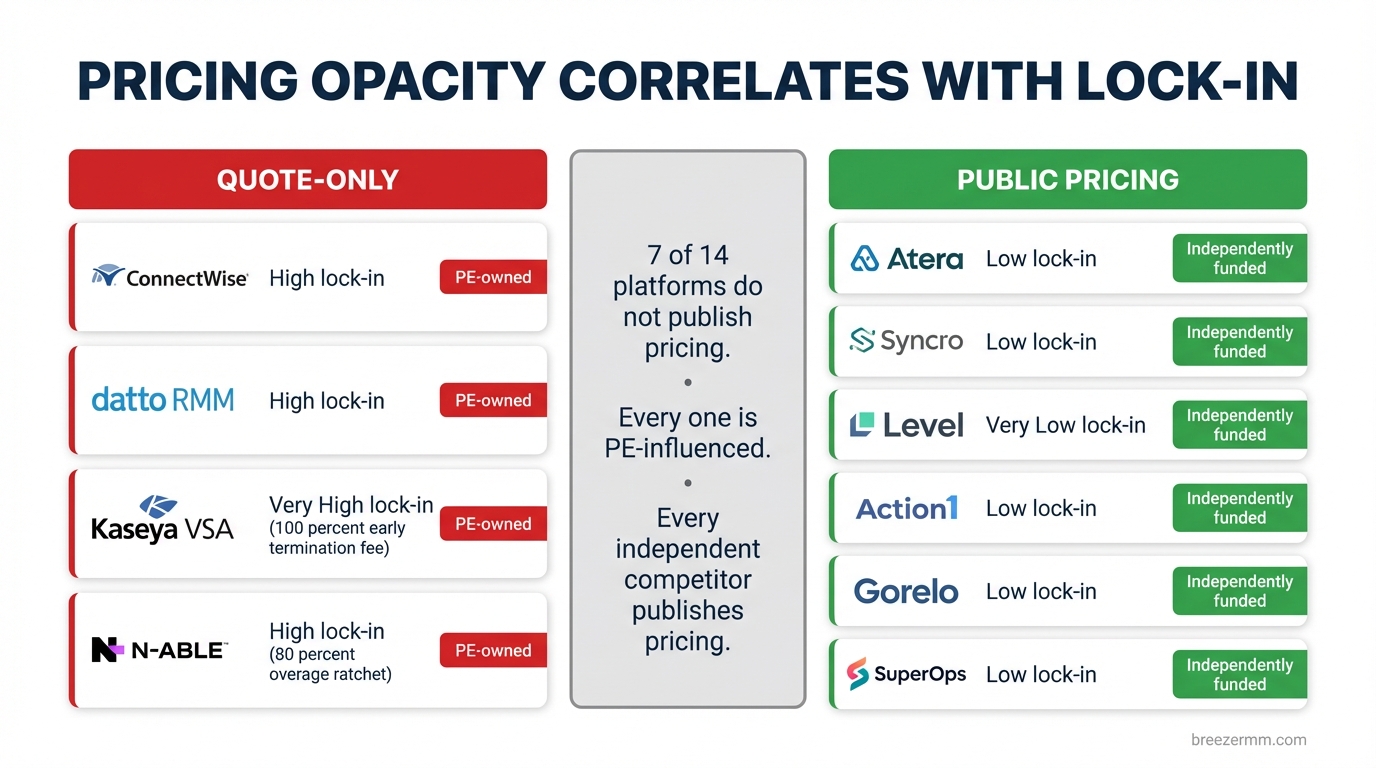
Seven of the fourteen platforms listed above do not publish pricing. For the five PE-owned platforms — ConnectWise, Kaseya VSA, Datto RMM, N-able N-central, and N-able N-sight — there is no way to estimate cost without a sales conversation. The pricing opacity correlates exactly with the highest contract lock-in.
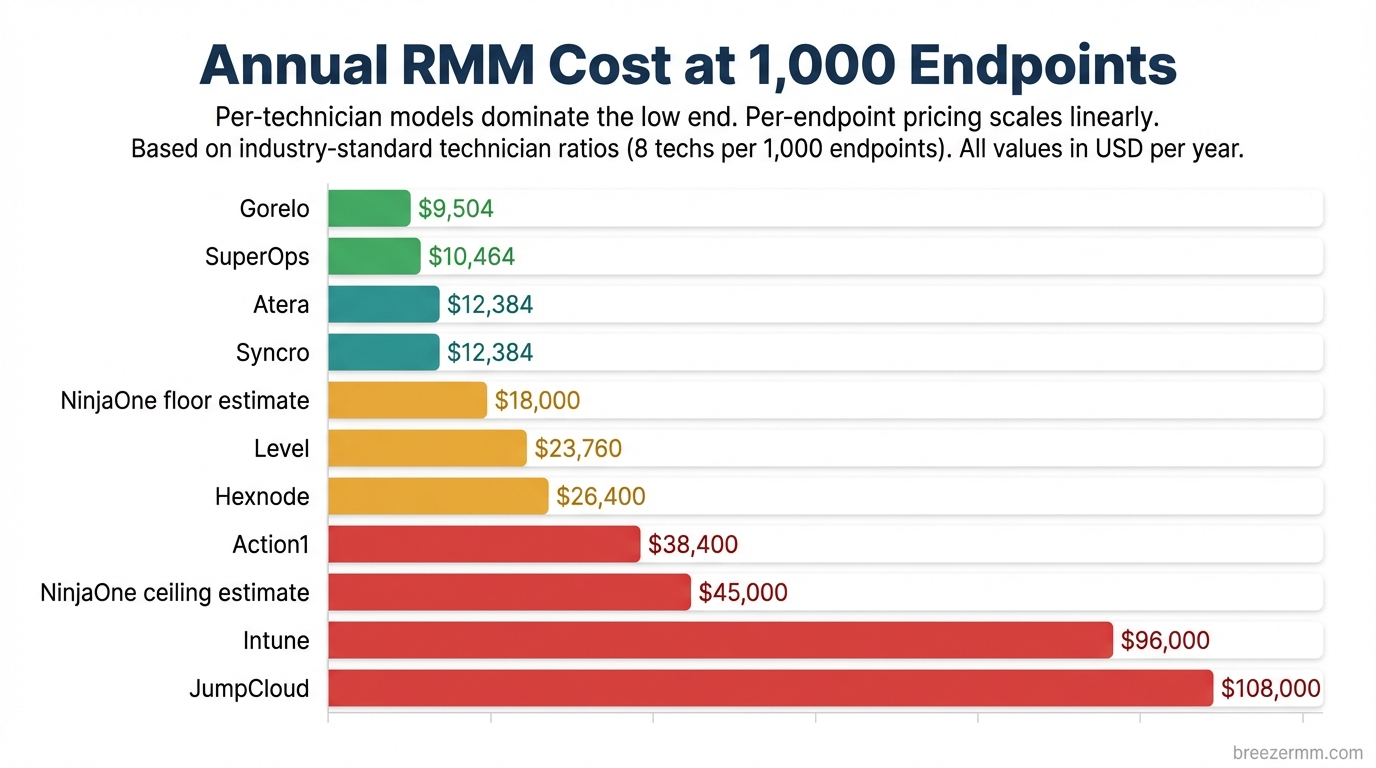
Annual Cost by MSP Size
Sorted by cost at Mid (1,000 endpoints). Only platforms with public or estimable pricing are included. Technician counts assume industry-standard ratios: 1 tech at 50 endpoints, 3 at 250, 8 at 1,000, 20 at 5,000, and 40 at 10,000.
| Platform | Plan | Solo (50) | Small (250) | Mid (1K) | Growth (5K) | Large (10K) |
|---|---|---|---|---|---|---|
| Action1 | Growth | Free | $2,400 | $38,400 | Quote | Quote |
| Gorelo | Launch | $1,188 | $3,564 | $9,504 | $23,760 | $47,520 |
| SuperOps | Standard | $1,308 | $3,924 | $10,464 | $38,760 | $76,620 |
| Atera | Pro | $1,548 | $4,644 | $12,384 | $30,960 | $61,920 |
| Syncro | Core | $1,548 | $4,644 | $12,384 | $30,960 | $61,920 |
| NinjaOne | Floor est. | $900 | $4,500 | $18,000 | $90,000 | $180,000 |
| Level | Flat | $960 | $5,760 | $23,760 | $119,760 | $239,760 |
| NinjaOne | Ceiling est. | $2,250 | $11,250 | $45,000 | $225,000 | $450,000 |
| Hexnode | Pro | $1,320 | $6,600 | $26,400 | $132,000 | $264,000 |
| Intune | Plan 1 | $4,800 | $24,000 | $96,000 | $480,000 | $960,000 |
| JumpCloud | Device Mgmt | $5,400 | $27,000 | $108,000 | $540,000 | $1,080,000 |
ConnectWise, Kaseya VSA, Datto RMM, N-able N-central, N-able N-sight, Pulseway, ManageEngine, Auvik, Naverisk, LogMeIn Resolve, Splashtop, TeamViewer, and ITarian are excluded because they do not publish pricing. If you have contract data for any of these, we will add them.
At 1,000 endpoints, the cheapest transparent option (Gorelo at $9,504/year) costs 60% less than Level ($23,760/year) and potentially less than a quarter of NinjaOne’s ceiling ($45,000/year). The per-technician model dominates the low end of the cost curve at scale.
Effective Cost Per Endpoint
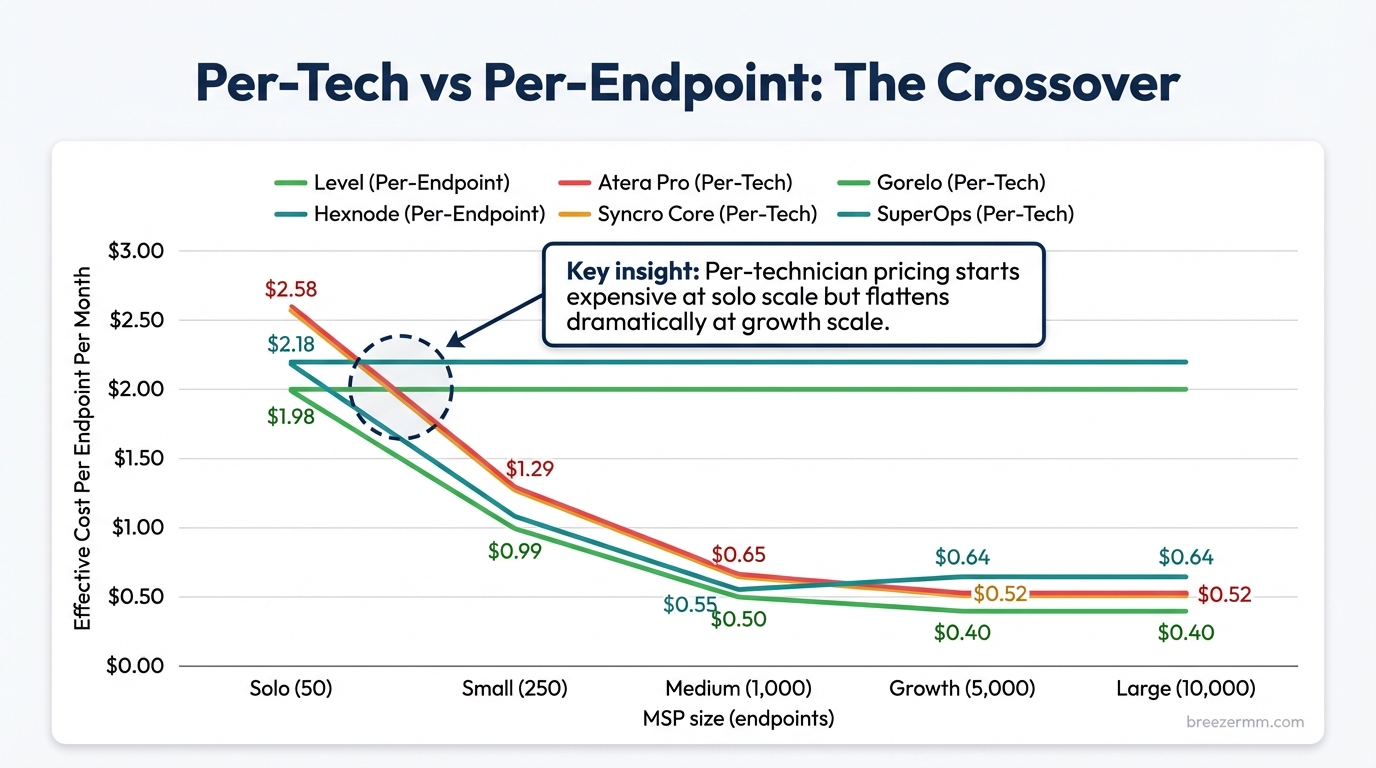
Per-technician pricing sounds expensive until you do the division. This table translates every pricing model into the same unit — dollars per endpoint per month — so you can compare directly. Technician counts use the same ratios as the annual cost table above.
| Platform | Plan | Solo (50ep/1tech) | Small (250ep/3tech) | Mid (1K ep/8tech) | Growth (5K ep/20tech) | Large (10K ep/40tech) |
|---|---|---|---|---|---|---|
| Gorelo | Launch | $1.98 | $1.19 | $0.79 | $0.40 | $0.40 |
| Atera | Pro | $2.58 | $1.55 | $1.03 | $0.52 | $0.52 |
| Syncro | Core | $2.58 | $1.55 | $1.03 | $0.52 | $0.52 |
| Level | Flat | $1.60 | $1.92 | $1.98 | $2.00 | $2.00 |
| NinjaOne | Range | $1.50–$3.75 | $1.50–$3.75 | $1.50–$3.75 | $1.50–$3.75 | $1.50 |
| SuperOps | Standard | $2.18 | $1.31 | $0.87 | $0.65 | $0.64 |
| Hexnode | Pro | $2.20 | $2.20 | $2.20 | $2.20 | $2.20 |
| Action1 | Growth | Free | $0.80 | $3.20 | Quote | Quote |
Per-technician pricing inverts the scaling curve. Per-endpoint is cheaper at small scale but scales linearly. Per-technician is more expensive at solo scale but flattens dramatically. The break-even points: Atera Pro ($129/tech) equals $1.50/endpoint at 86 endpoints per technician, equals $2.00/endpoint at 65, and equals $3.75/endpoint at 34. Gorelo ($99/tech) breaks even with $2.00/endpoint at just 50 endpoints per technician.
What You Get for the Money
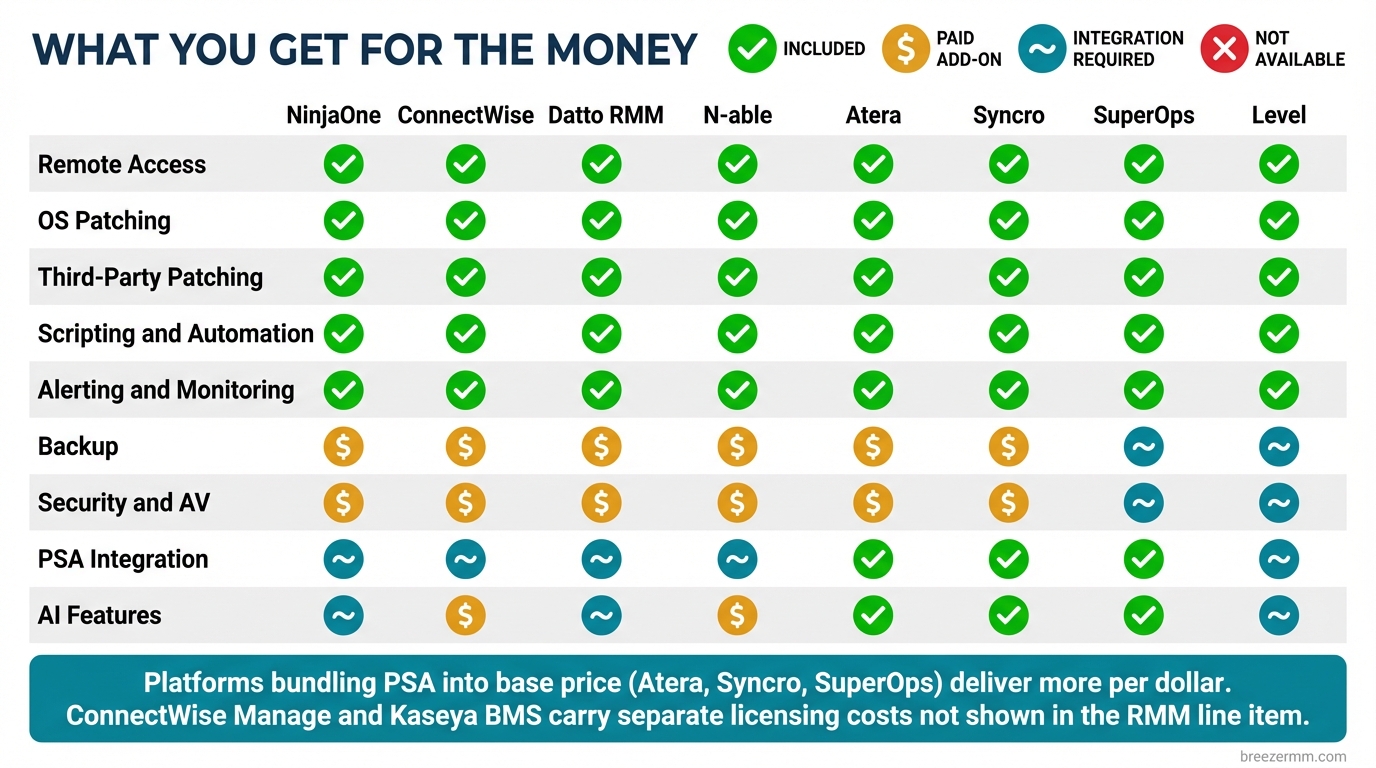
Core RMM capabilities are table stakes — every platform in this comparison includes patching, scripting, alerting, and remote access. The differentiation is in what costs extra and what requires a separate product entirely. Notation: ✓ = included, $ = paid add-on, ~ = integration or partner required, ✗ = not available.
| Feature | NinjaOne | ConnectWise | Datto RMM | N-able | Atera | Syncro | SuperOps | Level |
|---|---|---|---|---|---|---|---|---|
| Remote access | ✓ | ~ | ✓ | ✓ | ✓ | ✓ | ✓ | ✓ |
| Patch mgmt (OS) | ✓ | ✓ | ✓ | ✓ | ✓ | ✓ | ✓ | ✓ |
| Patch mgmt (3rd party) | ✓ | ✓ | ✓ | ✓ | ✓ | ✓ | ✓ | ✓ |
| Scripting/automation | ✓ | ✓ | ✓ | ✓ | ✓ | ✓ | ✓ | ✓ |
| Alerting/monitoring | ✓ | ✓ | ✓ | ✓ | ✓ | ✓ | ✓ | ✓ |
| Backup | $/bundle | ~/partner | ~/bundle | ~/partner | $ | $ | $ | ✗ |
| Security/AV mgmt | ✓ | ~/partner | ~/bundle | ~/partner | ✓ | ✓ | ✓ | ✓ |
| Reporting | ✓ | ✓ | ✓ | ✓ | ✓ | ✓ | ✓ | ✓ |
| PSA integration | ~ | ✓ (Manage) | ✓ (Autotask) | ~ | ✓ (built-in) | ✓ (built-in) | ✓ (built-in) | ~ |
| Mobile app | ✓ | ✓ | ✓ | ✓ | ✓ | ✓ | ✓ | ✓ |
| Multi-tenant | ✓ | ✓ | ✓ | ✓ | ✓ | ✓ | ✓ | ✓ |
| API | ✓ | ✓ | ✓ | ✓ | ✓ | ✓ | ✓ | ✓ |
| AI features | ✓ | ~ | ~ | ~ | ✓ | ~ | ✓ | ✗ |
| Network monitoring | ✓ | ✓ | ✓ | ✓ | ✓ | ✓ | ✓ | ✓ |
The differentiation is in what costs extra: backup, security integrations, PSA, and AI. The platforms that bundle PSA into their base price (Atera, Syncro, SuperOps) deliver more for the dollar than platforms that sell PSA as a separate product. ConnectWise Manage, Kaseya BMS, and N-able’s partner PSA integrations all carry their own licensing costs — costs that do not appear in the RMM line item but absolutely appear in the MSP’s operating budget. If your RMM comparison does not include the PSA cost, it is not a real comparison.
The Consolidation: $13B+ and Counting
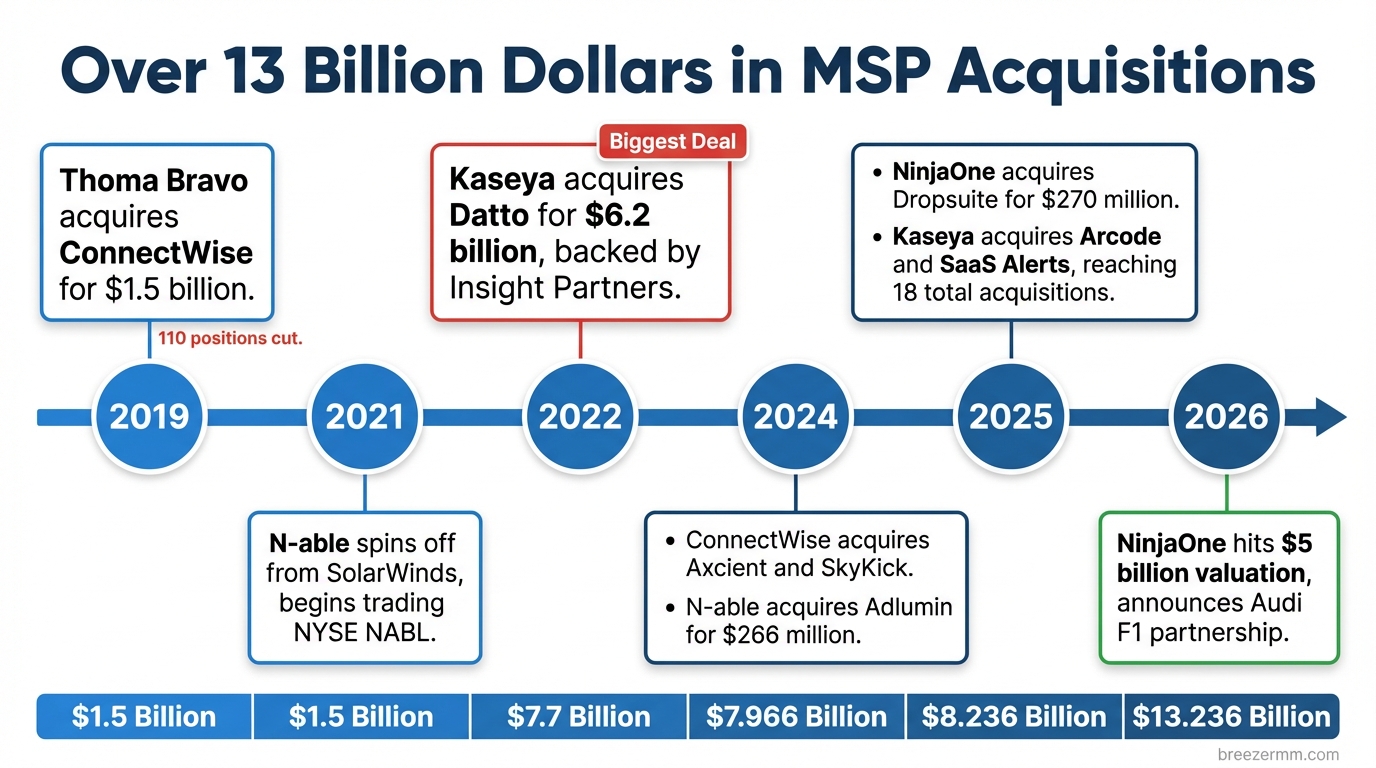
The pricing data above does not exist in a vacuum. Every quote-only form, every auto-renewal clause, every 80% overage ratchet exists because the structural conditions of the market permit it. To understand why RMM pricing works the way it does in 2026, you need to understand who bought what, when they bought it, and what happened afterward.
The Timeline
In 2019, Thoma Bravo acquired ConnectWise for an estimated $1.5 billion, per ChannelE2E reporting. Approximately 110 positions were cut on deal announcement. ConnectWise transitioned from an independent, partner-conference-driven company to a PE portfolio asset with return targets.
In 2021, N-able was spun off from SolarWinds on July 20 and began trading on the NYSE under the ticker NABL. The spin-off occurred in the aftermath of the SolarWinds Orion supply-chain breach — N-able inherited both the technical infrastructure and the reputational overhang.
In 2022, Kaseya acquired Datto for $6.2 billion, backed by an Insight Partners consortium. The deal created the largest MSP technology provider by product count, bringing Datto RMM, Autotask PSA, and the BCDR portfolio under Kaseya’s umbrella alongside VSA, IT Glue, and more than a dozen other products.
In 2024, ConnectWise acquired Axcient and SkyKick (data protection, cloud migration). N-able acquired Adlumin for up to $266 million ($220M cash, $16M stock, $30M earn-out). N-able explored a full sale in May but stayed independent. ConnectWise changed CEOs in September, replacing Jason Magee with Manny Rivelo.
In 2025, NinjaOne completed its acquisition of Dropsuite for approximately $270 million (SaaS backup). Kaseya acquired Arcode (email security) and SaaS Alerts, bringing its total to 18 acquisitions per MSP Success reporting.
In 2026, NinjaOne announced a multi-year partnership with the Audi Revolut F1 Team in January, backed by a $5 billion valuation and $500M+ in ARR. The combined acquisition value across these deals exceeds $13 billion.
The PE Playbook
There is a pattern to what happens after acquisition. It is observable in the contract terms, pricing structures, and community sentiment documented in the platform profiles above.
Pricing opacity increases. Products that once published per-endpoint rates move to quote-only models. Of the PE-influenced platforms in this report — ConnectWise, Kaseya VSA, Datto RMM, and N-able — none publish pricing. Every independently funded competitor does.
Contract terms tighten. Kaseya’s master agreement accelerates 100% of remaining fees on early termination. N-able’s subscription agreement ratchets 80% of overage consumption into the next year’s commitment floor. ConnectWise prohibits mid-term quantity reductions. These are not edge cases in the fine print — they are the core commercial mechanism.
Products get bundled, and standalone pricing becomes punitive. Kaseya 365 Endpoint exists to make buying VSA or Datto RMM individually less attractive than buying the bundle. The bundle discount is real, but so is the switching cost once your PSA, RMM, backup, and documentation all come from the same vendor.
Support headcount gets optimized. ConnectWise Automate’s Capterra rating for customer service is 3.7 out of 5. Kaseya VSA is 3.6. Community reports on r/msp describe longer ticket resolution times following acquisitions. Support is a cost center in a PE model, and cost centers get optimized.
Innovation focuses on acquisition rather than platform improvement. When a company has completed 18 acquisitions in a decade, engineering effort shifts toward integration and bundle packaging. The legacy platforms that MSPs depend on daily receive maintenance, not transformation.
The Ownership Map
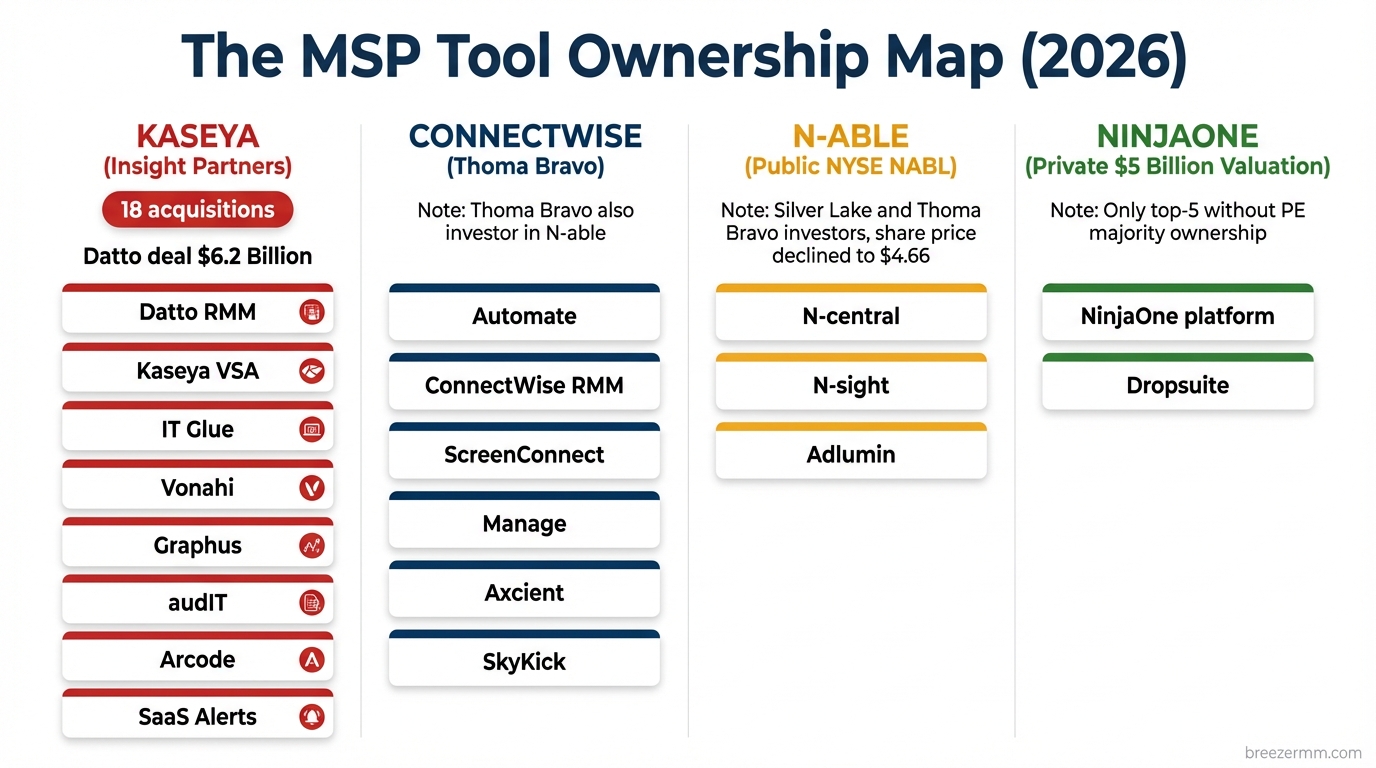
As of early 2026, the MSP tool market is controlled by four ownership groups:
Kaseya (Insight Partners) — Datto RMM, Kaseya VSA, IT Glue, Vonahi, Graphus, audIT, Arcode, SaaS Alerts, and ten additional products. 18 acquisitions total. The Datto deal alone was $6.2 billion.
ConnectWise (Thoma Bravo) — Automate, ConnectWise RMM, ScreenConnect, Manage, Axcient, SkyKick. Thoma Bravo also holds an investor position in N-able.
N-able (public, NYSE: NABL) — N-central, N-sight, Adlumin. Silver Lake and Thoma Bravo among investors. Share price declined from spin-off highs to $4.66 as of March 2026.
NinjaOne (private, $5B valuation) — NinjaOne platform plus Dropsuite. The only top-five vendor without PE majority ownership, though its $5 billion valuation and F1 sponsorship signal the scale of capital deployed.
The Security Cost
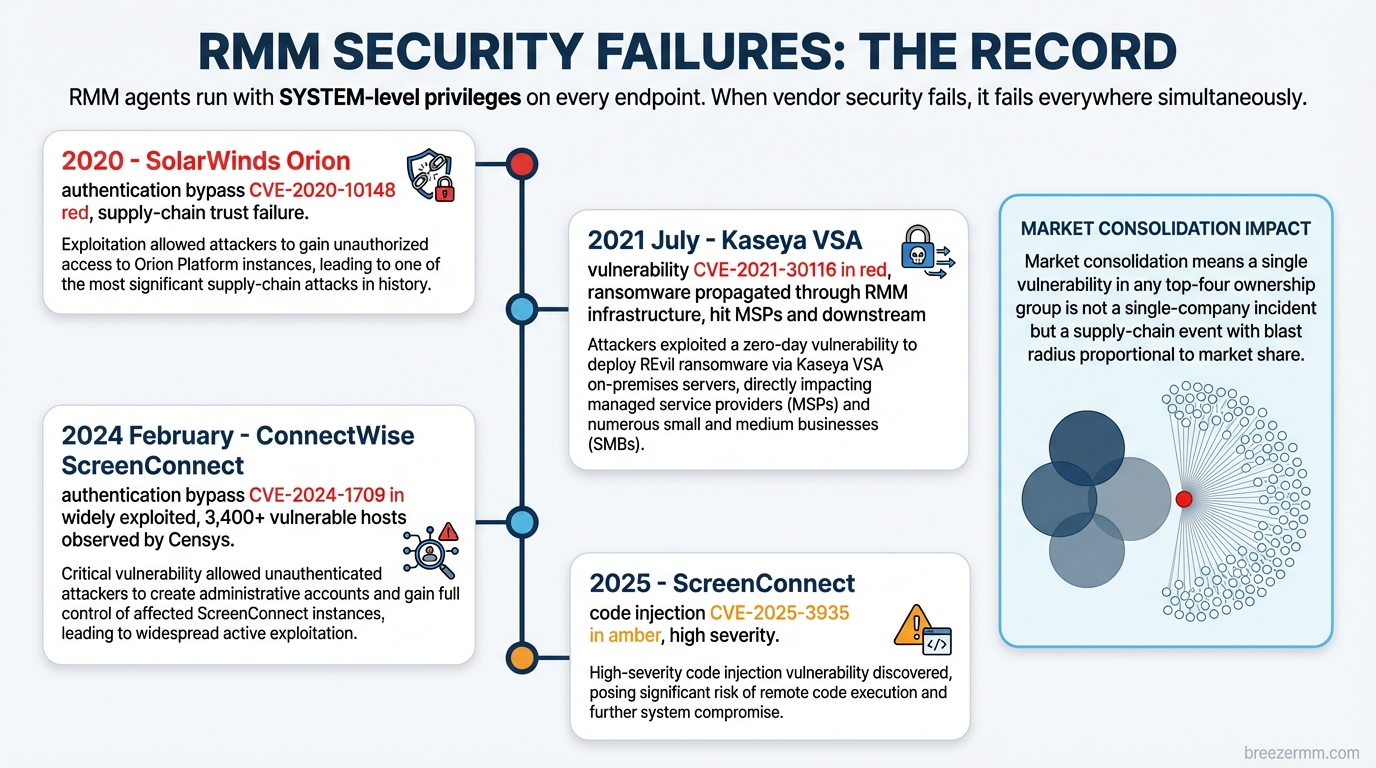
RMM agents run with SYSTEM-level privileges on every endpoint they manage. They execute scripts, install software, modify configurations, and access any file on the system. That access is what makes RMM useful. It is also what makes vendor security failures catastrophic.
The record speaks for itself. In 2020, the SolarWinds Orion authentication bypass (CVE-2020-10148) demonstrated that management-tool trust is a single point of failure. In July 2021, the Kaseya VSA vulnerability (CVE-2021-30116) was exploited in a ransomware campaign that propagated through the RMM infrastructure itself, hitting MSPs and their downstream clients in a single wave. In February 2024, a critical authentication bypass in ConnectWise ScreenConnect (CVE-2024-1709) was widely exploited, with Censys observing more than 3,400 vulnerable hosts. In 2025, a high-severity code injection vulnerability in ScreenConnect (CVE-2025-3935) added another entry to the management-server risk ledger.
Your RMM agent runs with SYSTEM-level privileges on every endpoint you manage. When the vendor’s security fails, it fails everywhere simultaneously. The consolidation of the market under a handful of vendors means a single vulnerability can affect a disproportionate share of managed endpoints globally. A critical vulnerability in any one of the top four ownership groups’ products is not a single-company incident — it is a supply-chain event with blast radius proportional to market share.
The Market Reality
Canalys reported the combined PSA and RMM market at $388 million in Q2 2024 alone. The top five vendors hold more than two-thirds of that market: ConnectWise at 24.3%, Kaseya at 22.7%, N-able at 11.4%, NinjaOne at 9.4%, and the remainder split among Syncro, Atera, and the long tail. The broader managed services market grew from $548 billion in 2024 to $608 billion in 2025. There are approximately 45,000 pure-play MSPs globally — closer to 90,000 at a looser definition that includes IT consultancies and VARs with managed service offerings.
The structural picture is straightforward. A concentrated market with opaque pricing, aggressive contract terms, and high switching costs is a market where the vendor captures a disproportionate share of the value. The pricing data in this report documents the mechanism. The acquisition timeline explains the incentive. The ownership map shows who benefits.
None of this means the incumbent products are bad. ConnectWise Automate is a powerful platform. NinjaOne’s growth reflects genuine product quality. Datto’s BCDR portfolio solves real problems. The question is not whether the products work — it is whether the commercial terms surrounding those products are structured to serve the MSP or the financial sponsor. The contract terms documented in the profiles above provide the answer.
Open Source and Self-Hosted Alternatives
The per-endpoint fee is zero. The cost is not.
Every MSP that has looked at the commercial pricing data in this report has had the same thought: what if we just run our own? Open source RMM tools eliminate the per-endpoint fee entirely. They also introduce a different cost structure — one that trades vendor margin for internal labor. Whether that trade makes sense depends on what your time is worth and how much of it the platform requires.
Tactical RMM
Tactical RMM is the most mature community-built MSP stack. It combines an agent, web interface, patching, scripting, and remote access into a single self-hosted deployment. Despite common description as open source in community discussions, Tactical RMM is source-available under a license that explicitly states it is not an open-source software license. The code is on GitHub and you can inspect it, but the license is not OSI-approved.
Tactical RMM offers paid self-hosted plans: $55/month for 0–199 endpoints, $80/month for 200–499, $100/month for 500–999, and $120/month for 1,000 or more. Cancel anytime — but canceling the license does not eliminate the operational cost of the VM, database, and integrations you are running. The license fee is the smallest line item. The labor to maintain the deployment is the largest.
Sources: Tactical RMM Pricing, Tactical RMM GitHub
MeshCentral
MeshCentral is Apache 2.0 licensed — genuinely open source, no asterisk. Originally an Intel project, it has accumulated 4,500+ GitHub stars and a dedicated community. The scope is narrower than a full RMM: MeshCentral is primarily remote access and device management, not patching, scripting, or monitoring in the way commercial RMM platforms define those features. It is often used alongside Tactical RMM to provide remote access capabilities.
The software itself is free. A typical small deployment runs $5–12/month in hosting costs. No official commercial support price card was found as of April 2026. If something breaks at 2 AM, the community forums and your own troubleshooting skills are the support contract.
Source: MeshCentral GitHub
OpenUEM
OpenUEM is Apache 2.0 licensed and launched in 2025. It earned the SourceForge Rising Star award in January 2026. The feature set covers asset inventory, remote assistance (VNC and RDP from the browser), software deployment via Winget, Flatpak, and Homebrew, Windows Update monitoring, and antivirus status tracking. It supports Windows, Linux (Debian and RedHat), and macOS.
SIXE, the company behind OpenUEM, offers professional deployment and support services. OpenUEM is the newest entrant on this list and the one most likely to close the feature gap with commercial RMM platforms over the next year — if the community and corporate backing sustain momentum.
Source: OpenUEM
NetLock RMM
NetLock RMM currently presents as a commercial product with a Pro tier at €55/month for unlimited devices. It is built by a German solo developer with public funding. The platform supports Windows, Linux, and macOS with Docker and Kubernetes deployment options. It can run fully air-gapped, which is a differentiator for environments with strict data sovereignty requirements.
Note: prior community claims of “25 free / open source” do not match the current commercial offering as of April 2026. Verify current terms directly before making procurement decisions.
Source: NetLock RMM Pricing
Flamingo / OpenFrame
Flamingo launched from stealth in October 2025 with a $2.2 million pre-seed round led by Focal VC and Array VC. OpenFrame is the open-source core platform. The product thesis is explicit: make the RMM the loss leader and monetize AI agents. Two AI agents are part of the pitch — Fae, a customer-facing agent for tasks like password resets and disk alerts, and Mingo, a backend agent for threat detection and routine maintenance.
The company claims a 1,000+ MSP waitlist via the OpenMSP community, which has 5,000+ members. Self-hosted is free; managed SaaS pricing is TBD as of April 2026. Flamingo is the earliest-stage entry on this list. The funding is real, the community interest is real, and the product is still taking shape.
Sources: Flamingo / OpenFrame, OpenMSP Community
Self-Hosted Total Cost of Ownership
The per-endpoint fee disappears with open source. The infrastructure and labor costs do not. This section puts real numbers on what self-hosting actually costs, with assumptions stated up front so you can adjust for your own situation.
Assumptions: $100/hour loaded labor rate (fully burdened cost including salary, benefits, overhead). $10/month infrastructure reserve for backups, monitoring, and DNS. Maintenance hours include updates, troubleshooting, security patches, backup verification, and on-call time.
Infrastructure reference points:
| Provider | Plan | Monthly |
|---|---|---|
| AWS Lightsail | 2 GB RAM | $10 |
| AWS Lightsail | 4 GB RAM | $20 |
| Hetzner Cloud | CPX21 | $12 |
| Hetzner Cloud | CPX31 | $21 |
| Hetzner Cloud | CPX41 | $39 |
| DigitalOcean Managed PG | Single node | $15 |
| DigitalOcean Managed PG | HA cluster | $30 |
| Aiven PostgreSQL | Developer | $5 |
Deployment scenarios:
| Scenario | Compute | DB | Other | Maint hrs/mo | Monthly Infra | Monthly Labor | Monthly Total | Annual |
|---|---|---|---|---|---|---|---|---|
| Lab / Solo MSP | Hetzner CPX21 ($12) | Aiven PG Dev ($5) | $10 | 4 | $27 | $400 | $427 | $5,124 |
| Small Production | AWS Lightsail 4GB ($20) | DO PG single ($15) | $10 | 6 | $45 | $600 | $645 | $7,740 |
| Mid Production | Hetzner CPX41 ($39) | DO PG single ($15) | $10 | 8 | $64 | $800 | $864 | $10,368 |
| HA Production | Hetzner CPX41 ($39) | DO PG HA ($30) | $10 | 12 | $79 | $1,200 | $1,279 | $15,348 |
The infrastructure cost is the small number. The labor cost is the large number. A Hetzner CPX21 and an Aiven developer-tier database cost $17/month. The four hours of maintenance time to keep them running cost $400/month. Infrastructure is 6% of the total in the lab scenario and 5% in the HA scenario. Labor is 94–95% of the cost in every scenario.
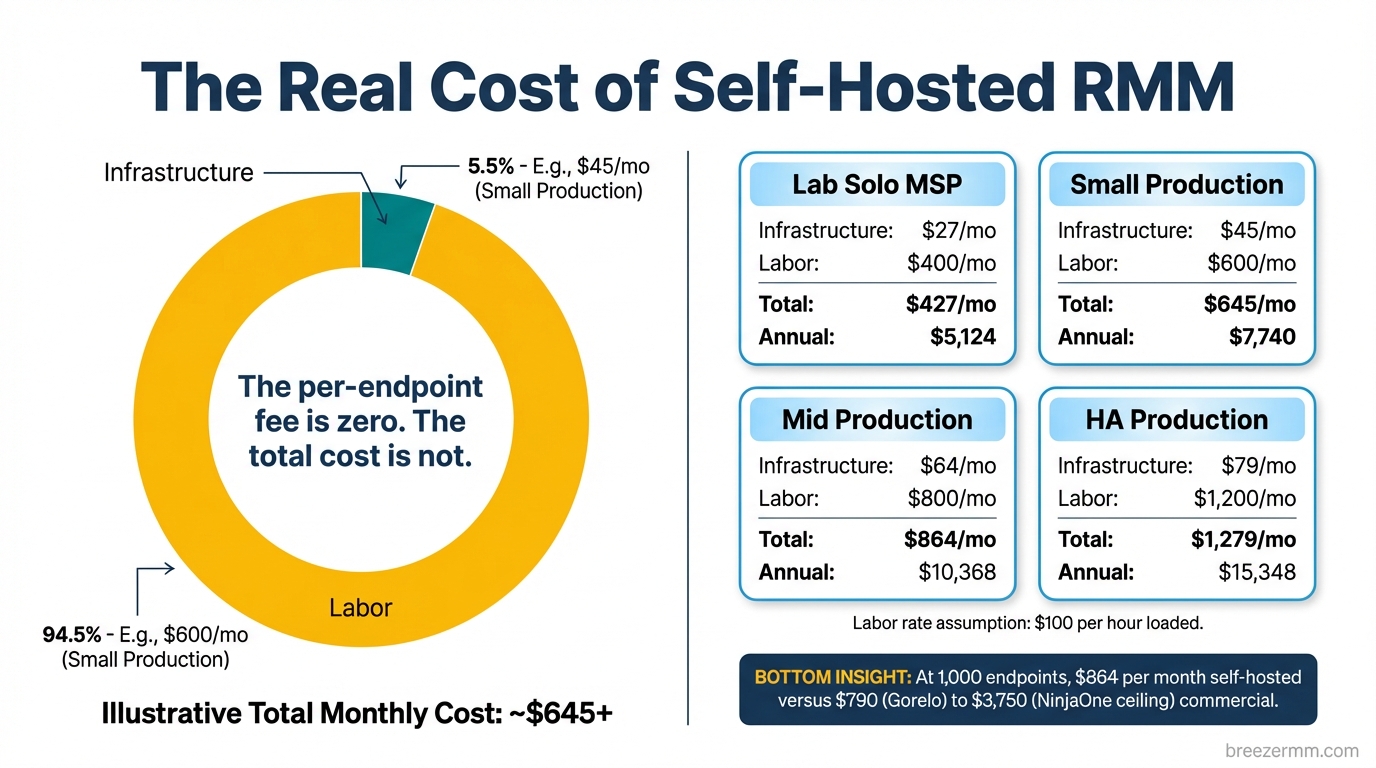
For a mid-size MSP running 1,000 endpoints, the $864/month self-hosted cost compares favorably to commercial options in this report — the transparent commercial range runs from $790/month (Gorelo) to $3,750/month (NinjaOne ceiling). But the comparison only works if you have someone capable of maintaining the deployment. If that person leaves, the maintenance hours do not disappear — they get redistributed to someone less familiar with the stack, and the effective hourly cost goes up.
Note: these estimates assume you are not also paying for Tactical RMM’s commercial license ($55–120/month). If using Tactical RMM’s paid plans, add that to the infrastructure line.
What you gain: no per-endpoint fees, no vendor lock-in, no contract, no auto-renewal traps, full control over the deployment, full data sovereignty, and the ability to leave at any time without paying an early termination fee.
What you lose: vendor support, compliance certifications (SOC 2, ISO 27001, etc.), out-of-the-box PSA integrations, pre-built third-party connector ecosystems, and someone else’s on-call rotation for infrastructure. When a commercial vendor has a security vulnerability, they patch it and push the update. When your self-hosted deployment has a security vulnerability, you are the one who patches it — and the clock starts when you notice, not when the vendor’s security team notices.
The honest answer is that open source RMM works well for MSPs that have strong internal technical talent and treat the platform as infrastructure they own. It works poorly for MSPs that adopt it to save money and then underinvest in the maintenance it requires. The per-endpoint fee is zero. The total cost of ownership is not.
Methodology and Sources
Every pricing figure in this report was verified against primary sources. Official vendor pricing pages are linked throughout — when a vendor publishes a price, we use it. When a vendor does not publish pricing, we say so explicitly and label the listing as quote-only. No prices were invented. Where community-reported figures exist, they are attributed to the source and given a confidence rating.
Confidence ratings follow a three-tier system used throughout the report. High means the data comes from an official, directly verifiable source — a pricing page, a published contract, a regulatory filing. Medium means the figure is aggregated from multiple credible sources that independently corroborate each other — review platforms, press coverage, vendor communications. Low means the data is anecdotal or community-reported, drawn from forums or individual accounts, and is clearly marked as such wherever it appears. For quote-only vendors like ConnectWise, Kaseya, and Datto, we present the best available community-reported ranges rather than fabricating estimates.
Published contract terms and legal agreements were reviewed directly. Where specific clauses are cited — auto-renewal windows, price increase provisions, early termination fees — the source document is identified. Review data was aggregated from G2 and Capterra. Community reports were drawn primarily from Reddit r/msp, the largest independent MSP forum. Market data comes from analyst reports, vendor press releases, and earnings disclosures.
Ninety-one sources were used in total. The report is updated periodically. Last update: April 2026.
If your pricing experience differs from what we documented, or if you have contract data that would improve accuracy, send it to [email protected]. Corrections are credited.
Source categories:
- Vendor pricing pages: NinjaOne, Atera, Syncro, SuperOps, Level, Action1, Gorelo, Hexnode, JumpCloud, Microsoft, Tactical RMM, MeshCentral, OpenUEM, NetLock RMM, Flamingo/OpenFrame
- Contract and legal terms: ConnectWise Commercial Terms, Kaseya Master Agreement, N-able SSA 2025, TeamViewer EULA
- Market and industry data: Canalys via ChannelE2E, Channel Futures, Datto/Kaseya State of the MSP reports
- Security disclosures: NVD (CVE-2020-10148, CVE-2021-30116, CVE-2024-1709, CVE-2025-3935), Censys
- Review platforms: Capterra, G2
- Community: Reddit r/msp
About This Report
This report is published by the team behind Breeze RMM, an open-source, AI-native remote monitoring and management platform. We built this because we are in the space and this data did not exist in one place.
The report is designed to be useful regardless of which RMM you choose. We are not included in the comparison tables. If you spot an error or your pricing experience differs from what we found, let us know — corrections make the report better.
If you would like to be notified when we update this report, subscribe below.