How to Sell CIS Coverage as a Managed Service
Most MSPs know they should be doing more around compliance. They hear it from vendors, from insurance carriers, from the clients who just filled out a 40-question cyber insurance questionnaire and have no idea what half of it means. But knowing you should do something and being able to build a profitable service around it are two different problems.
The reason most MSPs don’t package compliance as a service isn’t ignorance — it’s economics. When you actually run the numbers on what it costs to deliver a compliance report, the margins disappear fast. And without good margins, there’s no service.
That’s changing. Not because the frameworks changed, but because the tooling did. When continuous enforcement is automated, the cost to deliver compliance monitoring drops enough to make a standalone service tier viable. This post is about how to build and sell that tier.
Why the Numbers Never Worked Before
Let’s start with the real reason most MSPs don’t sell compliance coverage: it costs too much to deliver at a price SMBs will pay.
Generating a meaningful compliance report the traditional way means a technician pulling data from multiple tools — RMM, endpoint protection, patching, backup — normalizing it against a framework like CIS Controls, and writing a summary that the client can actually understand. That’s four to six hours of work. At $150 per hour fully loaded, you’re looking at $600 to $900 per client per report before you’ve touched a single remediation item.
At quarterly delivery, that’s $2,400 to $3,600 per year just for reporting. Add any actual remediation work and the number climbs quickly. Most SMB clients won’t pay $300 to $500 per month for compliance coverage — not because they don’t value security, but because they can’t see what they’re getting. And you can’t afford to charge them less when your delivery costs are that high.
The model doesn’t work. So most MSPs don’t offer it, and instead fold whatever compliance activity they do into the broader managed services agreement where it’s invisible and unbillable.
The Packaging Opportunity
The CIS Controls aren’t the most intuitive framework to sell, but they’re the right one for SMB clients for a simple reason: the first ten controls — sometimes called the Implementation Group 1 controls — are concrete, measurable, and achievable without enterprise-grade tooling or a dedicated security team.
A “CIS Essentials” service covering Controls 1 through 10 is a viable, differentiated offering. It’s specific enough to explain to a business owner and defensible enough to matter in an insurance conversation. The pitch isn’t complicated: you continuously monitor their systems against 18 security standards, automatically remediate the majority of issues you find, and deliver a monthly report showing exactly what was found and what was done.
That’s a tangible service with a tangible deliverable. Most managed services don’t have that. When a client asks what they’re getting from their MSP, the honest answer is usually “we keep things running and fix things when they break.” That’s valuable, but it’s invisible value — the client only notices when something goes wrong. Compliance coverage delivers visible, documented value every month.
Pricing Anchors That Actually Work
Per-device monthly pricing tied to report delivery is the right structure. Not per-site, not per-user — per device, because that’s where the coverage lives and that’s what scales cleanly as clients grow.
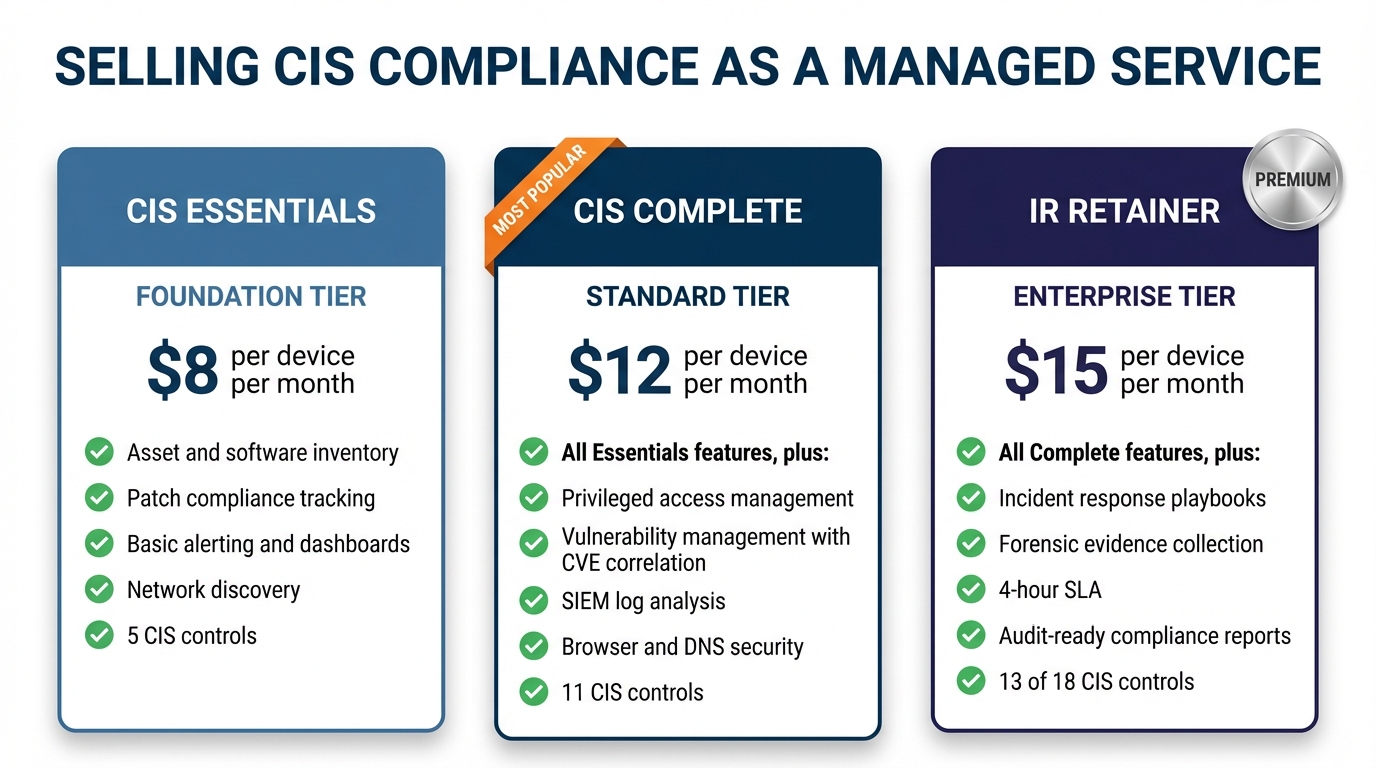
A reasonable starting point for CIS Essentials coverage is $8 to $15 per device per month, depending on your market and what’s bundled in. For a client with 50 devices, that’s $400 to $750 per month — a $4,800 to $9,000 annual contract. At that price point, you can afford to invest in tooling that automates the delivery.
The report is the proof of value. Clients can see their compliance score trend over time, what was auto-remediated, what’s still pending, and what requires their decision or budget. This changes the client conversation entirely. Instead of explaining abstractly that you’re protecting them, you’re showing them exactly what you found, what you fixed, and what’s left.
That paper trail also has downstream value for the client. Cyber insurance renewals, SOC 2 audits, client-facing compliance questionnaires — a 12-month history of monthly compliance reports is useful documentation. You’re not just delivering security, you’re delivering evidence of security.
The Client Conversation in Plain Language
CIS Control numbers mean nothing to a business owner. The conversation has to start with outcomes, not framework references. Here’s how to translate the controls that matter most:
Inventory and device discovery (CIS 1 and 2): “We continuously scan your network for unauthorized devices and alert you within hours of anything unexpected appearing. If someone plugs in a personal laptop or a rogue access point shows up, we know about it before it becomes a problem.”
Vulnerability management and patching (CIS 7): “We automatically find and patch critical vulnerabilities on your systems, typically within 48 hours of a patch being available. You don’t have to think about patch windows or maintenance schedules — we handle it and you see a report showing what was patched and when.”
Audit logging (CIS 8): “If a security incident ever occurs, we have 90 days of detailed logs to reconstruct exactly what happened — who accessed what, when, from where. That matters for insurance claims, for client notifications, and for understanding how to prevent it from happening again.”
Backup verification (CIS 11): “We test your backups every week to confirm they actually restore — not just that the backup job ran. Most ransomware victims discover their backups were broken after the fact. We find that out during a weekly drill instead of during a crisis.”
None of those explanations require the client to understand anything about security frameworks. They understand their own business problems, and each of those controls maps directly to a problem they’ve heard about or worried about.
The Evidence Artifact Is the Product
The monthly compliance report isn’t a supporting document — it’s the deliverable. This is the shift in thinking that makes compliance coverage work as a packaged service.
Traditional managed services create invisible value. Your clients don’t see the patches you applied, the alerts you triaged, the drive that was failing until you replaced it. The value is real, but it doesn’t accumulate in any form the client can show anyone. When a client gets acquired, when they face an insurance audit, when a new CFO asks why the IT bill is what it is — there’s no evidence file.
Monthly compliance reports change that. Twelve months of reports gives a client a documented security history. It shows their compliance score improving over time. It shows the issues you caught and remediated. It shows the decisions they made — the accepted risks, the deferred items, the things they chose to address versus defer. That’s a product they can point to.
It also changes the sales conversation. When you’re pitching a new client, you can show them what a report looks like. It’s concrete. It’s auditable. They understand what they’d be getting before they sign anything.
The Natural Service Tiers
A compliance service lends itself to a tiered structure that creates a clear upsell path without requiring you to pitch the client on something entirely different.
CIS Essentials covers Controls 1 through 10 with automated monitoring and monthly reporting. This is the entry point — the controls that are achievable for most SMBs without significant infrastructure investment. Automated enforcement handles the majority of issues; the report documents everything.
CIS Complete extends coverage to all 18 controls and adds incident response readiness: tabletop exercise support, response playbook documentation, escalation paths. This is appropriate for clients with more complex environments or compliance requirements, or clients who’ve had a scare and want more depth.
Incident Response Retainer sits above that — automated IR coordination with human lead oversight for actual incidents. Not every client needs this tier, but for clients who’ve been through ransomware or who operate in regulated industries, the retainer provides a named human and a defined SLA when things go wrong.
Each tier is a natural extension of the previous one. You’re not selling a client something completely different — you’re expanding the depth and scope of coverage they already understand.
The Insurance Angle Is Real and Growing
The cyber insurance market has materially changed what’s expected of SMB clients at renewal. Carriers that used to ask basic questions — “do you have antivirus?” — now ask about MFA enforcement, patch cadence, backup testing, and privileged access controls. These questions map almost directly to the foundational CIS Controls.
Clients who can hand their insurance carrier an automated compliance report at renewal are simplifying an increasingly painful process. They have documented evidence of security hygiene. They can answer the questionnaire with specifics instead of approximations. And in some cases, demonstrated compliance with recognized controls is starting to affect premium calculations.
This gives you a concrete reason to bring up CIS coverage in a renewal conversation. The client is already dealing with the questionnaire. You can either watch them struggle through it annually, or you can hand them a report that answers most of it automatically. That’s a different sales conversation than “you should think more about compliance.”
Why the Unit Economics Work Now
The reason this service is viable today when it wasn’t two years ago is that the delivery cost has dropped substantially. Continuous automated monitoring means you’re not paying a technician to pull data from four different tools and normalize it manually. The report generates itself. The auto-remediation runs on its own. The alert fires when something new appears on the network.
Your technician time goes to reviewing reports for anomalies, handling the issues that require human judgment, and having the client conversation about deferred items. That’s an hour or two per client per month, not four to six hours per report.
At $150 per hour, two hours of technician time per month is $300 in delivery cost. If you’re charging a 50-device client $500 per month for CIS Essentials coverage, the margin is real. The service is deliverable. And it compounds — as you add clients, the operational burden doesn’t scale linearly the way manual compliance delivery does.
That’s the business case. The framework is established. The client need is growing. The tooling now makes the economics work. The MSPs who build this service tier in the next 12 months will have a differentiated position that’s difficult for generalist competitors to replicate on price.
The question isn’t whether to offer compliance coverage. It’s how fast you can operationalize it.
Breeze RMM is built to make continuous compliance monitoring a standard part of how MSPs operate — not a custom engagement. If you’re thinking about building a compliance service tier, we’d be glad to talk through the specifics.